


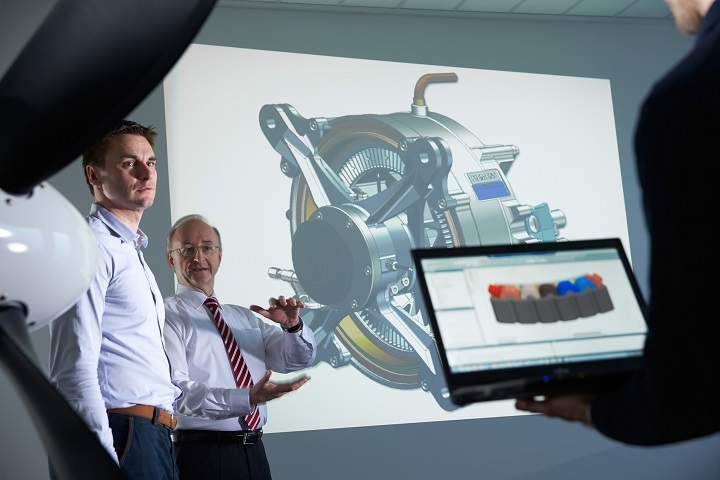
Siemens researchers have developed a new type of electric motor that, with a weight of just 50 kilograms, delivers a continuous output of about 260 kilowatts – five times more than comparable drive systems. This record-setting propulsion system successfully completed its first public flight today at Schwarze Heide Airport near Dinslaken, Germany, where it – almost silently – powered an Extra 330LE aerobatic airplane. The new drive system had already made its maiden flight on June 24th 2016. This advance means that hybrid-electric aircraft with four or more seats will now be possible.

The first-ever flight of a category CS23 Permit-to-Fly electric plane. The plane is powered by a 260 kilowatt Siemens motor that weighs a mere 50 kg – a record-setting power-to-weight ratio.
"This day will change aviation," said Frank Anton, head of eAircraft at Siemens' central research unit Corporate Technology. "This is the first time that an electric aircraft in the quarter-megawatt performance class has flown." The Extra 330LE, which weighs nearly 1,000 kilograms, serves as a flying test bed for the new propulsion system. As an aerobatic airplane, it's particularly well suited for taking the components to their limits, testing them and enhancing their design.
In addition, the company will be contributing this technology to the cooperative project that Siemens and Airbus agreed to in April 2016 for driving the development of electrically powered flight. Electric drives are scalable, and Siemens and Airbus will be using the record-setting motor as a basis for developing regional airliners powered by hybrid-electric propulsion systems. "By 2030, we expect to see initial aircraft with up to 100 passengers and a range of around 1,000 kilometers," explained Anton.
"The first flight of our propulsion system is a milestone on the road to electrification of aviation," said Siemens Chief Technology Officer Siegfried Russwurm. "To continue this journey successfully, we need disruptive ideas and the courage to take risks. That's why the development of electric propulsion systems for aircraft is also the first project for our new start-up organization, next47." Siemens is determined to establish hybrid-electric propulsion systems for aircraft as a future area of business.
Germany's Aeronautics Research Program (LuFo) supported development of this motor. The Extra 330LE was created in cooperation with Siemens, Extra Aircraft, MT-Propeller and Pipistrel (battery).
Which strategy leads to cost-effective, climate-friendly aviation in 2070? Four scenarios from the Bauhaus Luftfahrt think tank illustrate the impacts of different transformation paths. Key points: In...
Affirming Cathay’ ongoing commitment to growing Hong Kong’s connectivity with Belt and Road countries, Cathay Pacific is pleased to announce plans to launch direct flights to Almaty,...
dnata has secured a new multi-year contract with Silk Way Group to provide cargo and freighter handling services at Singapore Changi Airport (SIN), further strengthening a longstanding global par...
Bombardier Defense will provide three Global 6500 aircraft to fly maritime surveillance missions for the Australian Border Force. Metrea - the originator and leading provider...