


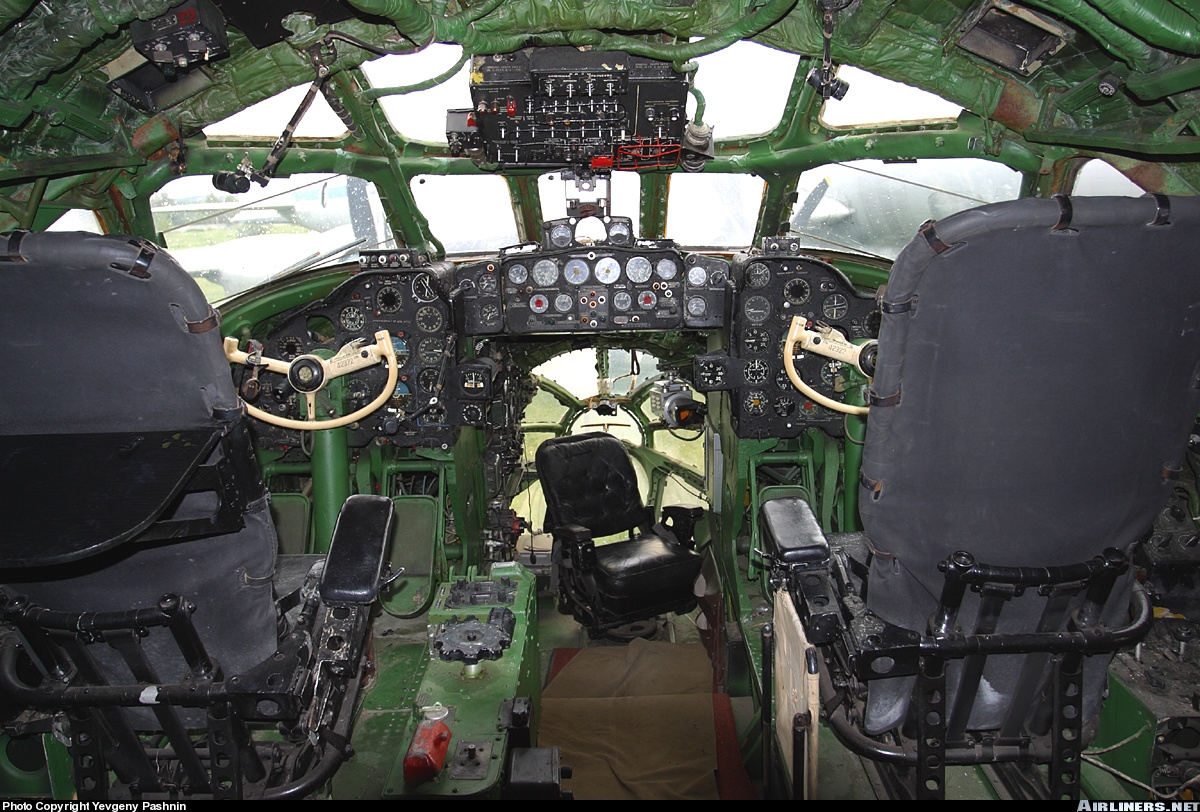
A London-based journalist had a tough job of compiling a profile of the Tupolev 104 for Aviation Week in 1956, based entirely on observations of its landing at London Airport, photographs, and experts such as engineers knowledgeable in typical Russian aircraft design. The result is a comprehensive look at the civil aircraft painted in the livery of Aeroflot, Russia’s state-run airline.

The Tu-104 profile was published in the April 2, 1956 issue of Aviation Week
The feature was published in the April 2, 1956 issue of Aviation Week in which readers learned a number of aspects of the aircraft which recently landed in London following a three-and-a-half hour flight from Moscow.
The paint “did not appear new and the aircraft gave evidence of having a considerable number of flying hours behind it.” It “carried the markings of Aeroflot. There was a blue stripe the length of the silver fuselage, a red flag on the tail, and a red hammer and sickle insignia below one of the escape hatches. Stylized Russian script “Tu” - for Tupolev – is on the nose.”
The writer said: “The twinjet aircraft shows sound design characteristics built into a contemporary airframe powered by two of the largest turbojet engines operating in the world today.”
The writer explained that designer Andrei N. Tupolev said the week before in an article published in Pravda, the official newspaper of the Communist Party in the Soviet Union, that his aircraft has a 2,000-mile range, cruising altitude of 33,000 ft. and cruising speed of 500 mph., was in “quantity production.”
The writer compiled a detailed feature with interesting technical information about the aircraft including the engines, the span of the “cigar-shaped” fuselage and further descriptions from studying photographs.
The magazine, not entirely politically correct by today's standard, often referred to Russians as “Reds”, the color of the Communist flag.
The writer managed to obtain a “very brief comment” from a British pilot, an assistant air attache, Squadron Leader J.J. Deverill, who flew with crew into London in the rain and was “aboard the aircraft to interpret air traffic control procedure for the Russian crew.”
Deverill said: “She flies beautifully,” but refused to make any further public comment.
The writer and some observers of the aircraft wonder whether it is a passenger version of the military Ilyushin Badger, an Ilyushin design, seeing as it bears some similarities including the tail, landing gear and nose. “The engines appear to be mounted further outboard on the jetliner than on the Badger.”
“The argument between observers as to whether the Tu-104 is a Badge development or not and as to whether Tupolev designed the Badger are no nearer settlement than they were before the plane came into London, since there has been no comparable opportunity for western observers to examine a Badger.”
“Most obvious points of similarity between it and the Badger are in the nose of the fuselage, the vertical tail and the landing gear in separate nacelles.”
He added that the fuselage appears to have a passenger feel to it with a new set of wings built around it. “This is a reasonable assumption, considering the Russian engineering tendencies to pool technical features t standardize on sub-assemblies as much as possible.”
“It is entirely possible that the complete nose and cockpit assembly has been standardized for use on all large Red aircraft, whether military or civil.”
Fuel is stored in the wings and the lower part of the fuselage. “Some 8,000 Imperial gallons (9,600 U.S. gals.) of jet fuel were taken aboard after the 1,564-mi. flight from Moscow.” And according to Russian sources, the plane has a 52-passenger seat arrangement which are pale blue inlaid with walnut paneling.
The aircraft’s most impressive feature, according to the report, is size and thrust of the Roll-Royce engines and are “probably the same as those used in the Badger and Bison bombers.”
One British engineer said: “I reckon these Badger engines to deliver about 22,000 lb., based on our estimates of tailpipe diameter. Also we know the Russians to be logical chaps who would use nice round figures for design. And 22,000 lb. is 10,000 kilograms.”
The report observed: “The general attitude of Western observers is that the engines are very high-powered, and any attempt to depreciate their thrust to the 12,000 lb. level is wishful thinking.”
The European tour of Daher Aircraft’s “go-anywhere” Kodiak 900 multi-role airplane continues this week at the France Air Expo 2026 event in Lyon, France, where it will join a fast, e...
Air passenger rights in Europe are at a critical crossroads. On June 2, the European Union’s Conciliation Committee will meet for a final round of negotiations on the revision of the European re...
Deutsche Aircraft is preparing its most comprehensive showcase to date, highlighting the evolution of its future ready, multi role aviation portfolio designed for governmental and mission critica...
Which strategy leads to cost-effective, climate-friendly aviation in 2070? Four scenarios from the Bauhaus Luftfahrt think tank illustrate the impacts of different transformation paths. Key points: In...