


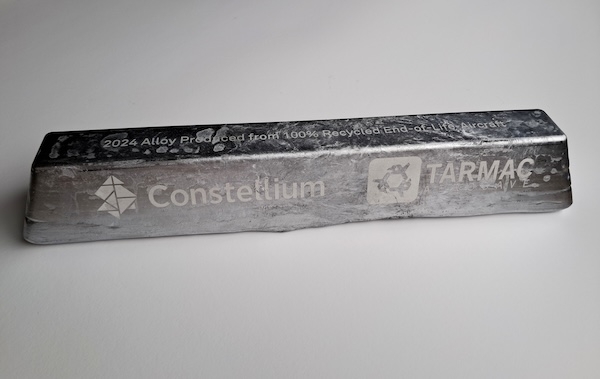
TARMAC Aerosave and Constellium SE are proud to jointly announce a major milestone in sustainable aerospace innovation: the successful recycling and remelting of aluminum from end-of-life aircraft into new, high-performance material suitable for future aerospace applications. This milestone highlights the potential of aluminum to support circular economy goals in aerospace, without compromising material performance.
Following months of collaborative research and development, supported in particular by Airbus and ValoER, Constellium has successfully remelted aluminum recovered by TARMAC Aerosave from retired commercial aircraft, producing material that meets the stringent performance requirements for new aircraft manufacturing. The next step will be to scale up this process for industrial application and to extend it to any aluminum alloy used in metallic aircraft, further demonstrating the full recyclability of end-of-life metallic airframes.
Alexandre Brun, President and CEO of TARMAC Aerosave commented: “The circularity of aeronautical materials is at the heart of TARMAC Aerosave's DNA. It's what built its worldwide reputation as a leader in aircraft recycling, before becoming a one-stop shop. Aluminum is one of the materials that we have always sought to sort and recover in the best possible way in order to increase our recycling rate, which is now more than 92%. We’re proud to have joined forces with partners who share our commitment to advancing circular solutions for aviation.”
Philippe Hoffmann, President of Constellium’s Aerospace and Transportation business unit stated: “At Constellium, recycling is at the core of what we do. We have extensive experience in giving aluminum an endless life across various industries. What makes this initiative truly exciting is that it demonstrates - through a real-world example - that even complex aerospace aluminum alloys from end-of-life aircraft can be fully recycled into material suitable for new aerospace applications. It’s a proof point for the circular economy in aviation.”
Aluminum recycling uses only 5% of the energy required for primary production and emits 95% fewer CO₂ emissions. Recycling also protects resources and reduces waste, making it a powerful lever for improving the sustainability of the aerospace industry. As the sector intensifies efforts to reduce its carbon footprint, this full-circular model provides a compelling path forward for future innovation and sustainability.
Bell Textron announced the order of the first Bell 407GXi helicopter in India to TransBharat Aviation Private Limited, one of India’s most established non-scheduled rotary-wing operators. F...
Air passenger rights in Europe are at a critical crossroads. On June 2, the European Union’s Conciliation Committee will meet for a final round of negotiations on the revision of the European re...
The A350-1000ULR (MSN 707), the first of 12 aircraft ordered by Qantas has completed its first flight in Toulouse, France. The aircraft, fitted with special flight test instrumentation, flew for three...
Baltic Ground Services, an international provider of ground handling and aircraft fueling services, has expanded its cooperation with Turkish leisure carrier Freebird Airlines across several airports...