


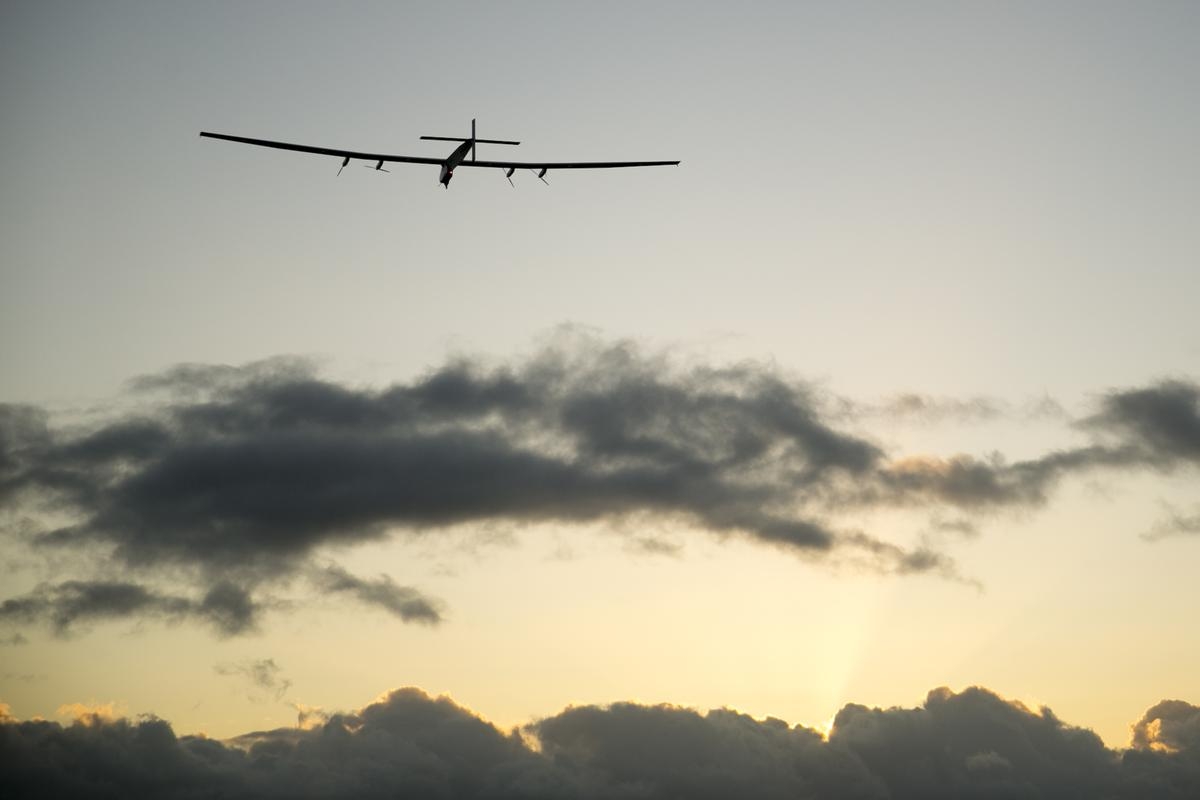
Two pilots are slowly carving their way into a new future of solar-powered flight as one embarks on the latest leg of their around-the-world journey in a plane powered only by the sun.
After some uncertainty about winds, the Solar Impulse team took off from Hawaii on Thursday, and hours later it was still ascending over the Pacific attempting to reach a high altitude before night sets in.
The Swiss-made Solar Impulse 2 was on course to land in Mountain View, California, in about three days. The crew that helped it take off was clearing out of its Hawaiian hangar and headed for the mainland for the weekend arrival.
The aircraft landed in Hawaii in July and was forced to stay in the islands after the plane's battery system sustained heat damage on its trip from Japan.
The aircraft started its journey in March 2015 from Abu Dhabi, the capital of the United Arab Emirates, and made stops in Oman, Myanmar, China and Japan. It's on the ninth leg of its circumnavigation.
Pilot Bertrand Piccard, who is flying the latest leg of the trip, said the idea of crossing the ocean in a solar-powered plane a few years ago stressed him out, but Thursday he was confident things would go according to plan.
Piccard also said the destination in the heart of Silicon Valley is fitting. He said on his way to the airfield that the plane will land "in the middle of the pioneering spirit."
Piccard's co-pilot Andre Borschberg, who flew the leg from Japan to Hawaii, told Piccard he greatly admires his dedication and strength.
He said the plane "represents what we could do on the ground in our communities."
The team was delayed in Asia, as well. When first attempting to fly from Nanjing, China, to Hawaii, the crew had to divert to Japan because of unfavorable weather and a damaged wing.
A month later, when weather conditions were right, the plane departed from an airport in Nagoya in central Japan for Hawaii.
The trans-Pacific leg is the riskiest part of the plane's global travels due to the lack of emergency landing sites.
The plane's ideal flight speed is about 28 mph, though that can double during the day when the sun's rays are strongest. The carbon-fiber aircraft weighs more than 5,000 pounds, or about as much as a midsize truck.
The wings of Solar Impulse 2, which stretch wider than those of a Boeing 747, are equipped with 17,000 solar cells that power propellers and charge batteries. The plane runs on stored energy at night.
Following the successful first flight and Roll-Out of the demonstrator aircraft of the Do228 NXT series, German aircraft manufacturer General Atomics AeroTec Systems announced the sale of the first Do...
Avincis, Europe’s largest emergency aerial services operator, and Airbus Helicopters have signed a contract for up to 15 H145 helicopters. The new aircraft will be deployed across Avincis’...
Etihad Airways announced the launch of two new European routes this June: direct services to Kraków, and Palma de Mallorca. These additions mark a significant milestone in Etihad’s e...
United unveiled a new specialty "Stars and Stripes" livery that celebrates the nation's 250th anniversary and announced a milestone to the airline's United Military Pilot...