


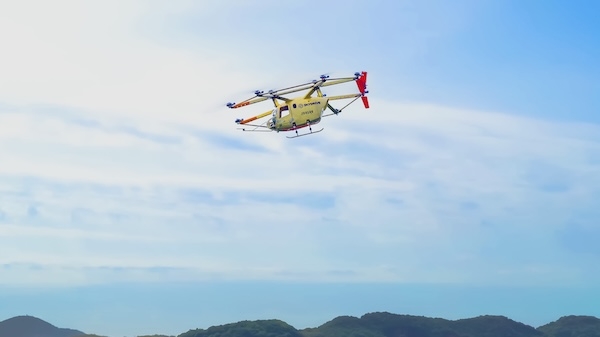
SkyDrive successfully accelerated its SKYDRIVE aircraft to a speed of 100km/h, a viable speed for the commercialization of short hop inter-urban air mobility. Through a series of high speed tests, SkyDrive has verified aircraft’s high-speed stability, controllability, and maneuverability, as well as the performance of the propulsion systems, flight control systems and on-board avionic equipment.
The data gathered through the high-speed flight test campaign allows SkyDrive’s engineers to confirm the accuracy of the aircraft characteristics and dynamic behavior predicted in advance of actual aircraft testing through advanced design and analysis, marking another major step towards type certification and the planned commercialization of the aircraft in 2028.
The significance of achieving stable flight at 100km/h goes beyond simply reaching a certain number on the airspeed indicator. Aircraft development begins with design and analysis, proceeds through individual system tests and ground tests, and then moves on to the manufacture of a full-scale aircraft and flight testing. At the same time, simulators are used to repeatedly verify flight characteristics, propulsion systems, and flight control systems.
Simulation, analysis and ground testing are all key parts of the process, but the final flight testing stage is critical. There are some things that cannot be known until the aircraft actually flies. This is particularly true of high-speed flight, where aerodynamic forces, vibrations, structural loads, and flight control system response all change and interact in complex ways. Flight testing is the only way to verify whether the results predicted during the design phase accurately describe the aircraft’s in-flight behavior.
As SkyDrive’s aircraft is based on a completely new concept, distinct from conventional fixed-wing aircraft and helicopters, we cannot assume that existing knowledge and flight data will apply. Every new aircraft needs to collect and verify data through actual flight tests, but with a new aircraft concept, this phase becomes even more indispensable.
Benefits of reaching 100km/h with SKYDRIVE multicopter
During high-speed flight, aerodynamic forces, vibrations, structural loads, propulsion systems and flight control all change significantly, as do the interactions between them. High speed testing is a critical stage of aircraft development as it allows us to confirm the appropriateness of our design and the precision of our prior analyses.
Flight testing also frequently reveals new challenges. If the data from actual flight testing differs significantly from the data assumed at the design and analysis stage, it can result in the need for additional testing, design changes, and even the revision of existing development plans. Current flight test campaign has allowed us to confirm the stability, controllability and structural integrity of the aircraft, as well as the functionality of the aircraft’s various systems. The results show that the observed flight characteristics and behavior match our expectations from the design and analysis phase.SkyDrive is now able to move the development forward toward the certification and commercialization of the aircraft with a higher degree of visibility and predictability.

The recent high speed forward flight tests conducted by SkyDrive demonstrate the utility of the compact multicopter concept that SkyDrive has pursued since the company’s founding.SkyDrive’s multicopter design, which eschews fixed wings, is optimized for use in urban airspaces. A compact design not only allows for wider flexibility in takeoff and landing locations, it also keeps the aircraft structure and operations as simple as possible, reducing operational costs and improving maintainability.
The compact multicopter design represents a revolution in aviation. However, while the new design brings many benefits, it also means that the aircraft testing cannot rely on the past data collected from existing commercial aircraft models. This makes it particularly important for SkyDrive to show that its aircraft can fly safely at the speeds required for commercial operations and also that the compact multicopter design is truly feasible for urban airspace use.
Through these recent high speed tests, SkyDrive has confirmed that our aircraft architecture, which uses 12 independent rotors under the control of a central flight control system, functions as designed in high speed forward flight, a confirmation that further underscores the feasibility of using the aircraft for short-hop urban flights. 100km/h is not just a number. It is an important step towards the establishment of multicopters as a new and efficient means of urban transport.
Around the world, many companies are developing eVTOL aircraft. The industry is currently moving beyond the phase of demonstrating that such aircraft can actually fly and into a more advanced phase of gathering the evidence required to show that the aircraft can operate stably at high speed, collecting the data required by regulatory authorities for certification, and demonstrating the viability of future commercial operations.
SkyDrive’s will continue with high speed testing to expand the aircraft’s flight envelope at the speeds required for commercial operation, collect further data and know-how, and clarify that the flight performance of the aircraft continues to match the performance expectations predicted during the design and analysis phase. SkyDrive journey towards certification and the start of commercial operations in 2028 continues.
Tecnam announced the appointment of Altair Solutions as its Official Maintenance, Training and Certified Pre-Owned Partner, reinforcing its long-standing commitment to customer excellence an...
United is accelerating the rollout of fast, free Starlink Wi-Fi for MileagePlus members as United flight 14 is set to depart Newark/New York for London this evening aboard a Boeing 777-200, marking th...
Jet Aviation has signed a 30-year lease with SR Aviation Infrastructure and Business Aviation Group, to operate an FBO at Rocky Mountain Metropolitan Airport. The FBO is part of a newly developed...
Lufthansa Technik Philippines, the joint venture between Lufthansa Technik and the MacroAsia Corporation, is significantly expanding its footprint in the Philippines with a new base maintenance facili...