


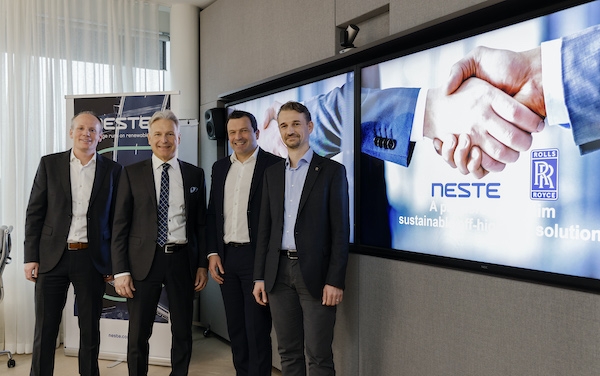
Rolls-Royce and Neste have signed a MoU to build a strategic partnership on the implementation of sustainable fuels for diesel engines. Both companies share a common vision: that sustainable fuels will play a key role in reducing greenhouse gas emissions in off-highway applications. The main components of the agreement are: promoting the use of existing internal combustion engines for sustainable fuels; advancing the transition from fossil fuels to sustainable fuels; and knowledge sharing on high-quality renewable diesel (HVO).
Tobias Ostermaier, President – Stationary Power Solutions, within the Rolls-Royce business unit Power Systems, which makes engines under the mtu brand, commented: “Through our ‘Net Zero at Power Systems’ sustainability program, we have committed to realigning our mtu product portfolio so that by 2030, sustainable fuels and new mtu technologies will reduce greenhouse gas emissions by 35 percent compared to 2019. This near-term target plays an important role in helping the whole of Rolls-Royce realise its net zero ambitions. Our agreement with Neste, the world’s leading producer of renewable diesel, will help us achieve our goals and those of our customers.”
‘Neste MY Renewable Diesel’ produced from 100% renewable raw materials
‘Neste MY Renewable Diesel’ is produced from 100% renewable raw materials. Lars Peter Lindfors, Senior Vice President Innovations at Neste, said: “With ‘Neste MY Renewable Diesel’ greenhouse gas emissions can be reduced by as much as 75% to 95%* when emissions over the fuel’s life cycle are compared with fossil diesel. Companies can reduce their climate emissions significantly in an instant by just changing the fuel.”
Rolls-Royce tests show HVO use significantly reduces CO2, nitrogen oxide and particulate emissions
Michael Stipa, Vice President Stationary Strategy, Business Development and Product Management for the Power Systems division of Rolls-Royce, said: “Since May 2022, Rolls-Royce has approved mtu diesel engines for Power Generation for renewable diesel (also known as HVO) and other EN15940 fuels. The tests we have done show an up to 90% greenhouse gas reduction, up to 80% less particulate emissions and an average of 8% nitrogen oxides reduction. All our tests revealed full performance without modifications to the engines.” Power Systems is gradually releasing its main mtu engine series for sustainable fuels such as HVO and e-diesel for use in other applications such as rail, marine and the construction industry.
“Both Neste and Rolls-Royce are aimed to reach their climate targets and to support the customers’ journey towards sustainability. In order to achieve this, cooperation is really key,” said Mats Hultman, Head of OEM Partnerships at Neste.
Growing availability of renewable diesel and other renewable products
Neste currently has a renewable products global production capacity of 3.3 million tons annually. Neste’s ongoing Singapore expansion project and a joint venture with Marathon in Martinez, CA, that is still pending completion, will increase the total production capacity of renewable products to 5.5 million tons by the end of 2023. It will make Neste the only global provider of renewable fuels and renewable feedstock for polymers and chemicals with a production footprint on three continents. When completed, the expansion of its Rotterdam refinery will further increase the company’s total production capacity of renewable products to 6.8 million tons by the end of 2026.
Rolls-Royce and Neste already testing sustainable aviation fuel on Airbus A350 in 2021
Rolls-Royce has experience of working with Neste on sustainable fuels in other parts of its business. In November 2021, Rolls-Royce and Neste, alongside Airbus and German research centre DLR, conducted a world-first study of the impact of 100% sustainable aviation fuel (SAF) on both engines of a commercial jet. The study marked the first time 100% SAF had been measured simultaneously on both engines of a commercial passenger aircraft – an Airbus A350 aircraft powered by Rolls-Royce Trent XWB engines from its Civil Aerospace division.
*The GHG emission reduction percentage varies depending on the region-specific legislation that provides the methodology for the calculations (e.g. EU RED II 2018/2001/EU for Europe and US California LCFS for the US), and the raw material mix used to manufacture the product for each market.
Britten-Norman launched the Global Aircraft Recovery service, delivered in collaboration with specialist partners including Avitrius Air International. The service has already proven its capability in...
Prince Aviation hosted the annual summit of the Citation Mustang Interest Group (CMIG) at its facility at Belgrade airport from 4 to 6 June 2026. The event brought together Citation Mustang owners and...
Airbus inaugurated a second modernized final assembly line for the A320 family at the Jean-Luc Lagardère site in Toulouse. The official opening ceremony was presided over by Guillaume Faury, Ex...
Embraer signed a new long-term agreement with the Brazilian Air Force to provide support solutions for its KC-390 Millennium fleet. The agreement strengthens the partnership between Embraer and t...