


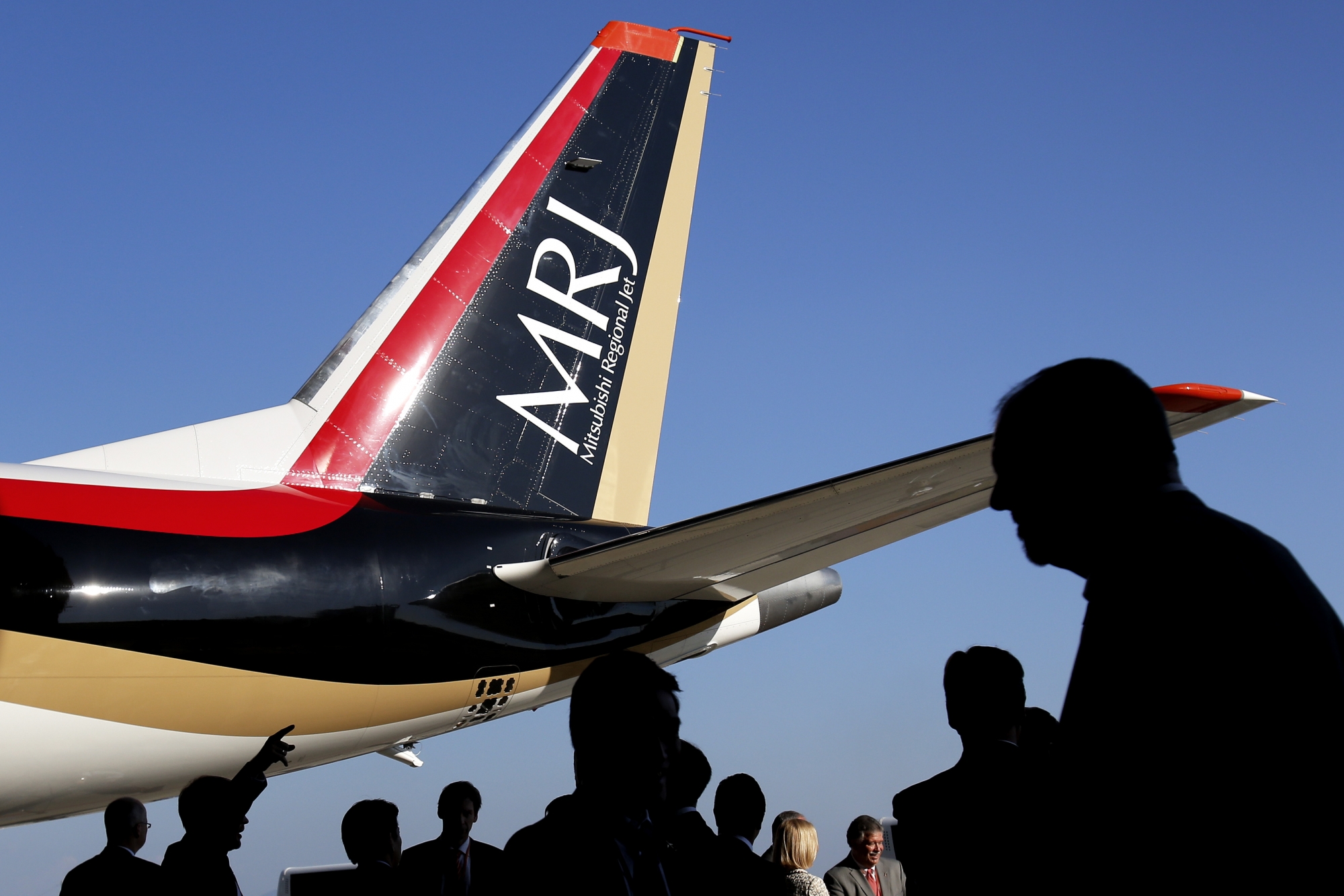
Mitsubishi Aircraft will strengthen the MRJ regional jet’s airframe and upgrade its software, following an announcement last week about a year-long delay to the aircraft’s delivery schedule.
The Japanese manufacturer tells Flightglobal that it has scheduled two months to strengthen the aircraft’s airframe, as well as upgrade the software for its avionics, flight control system and engine control unit. Data gleaned from static strength tests prompted the modifications.
Part of the work includes strengthening the jet’s wings. When “ultimate weight loads exceeding normal loads” were exerted on some components during static strength tests, it became clear which components lacked sufficient strength, says Mitsubishi.
“Also, we are strengthening the fuselage after test feedback. We have been reinforcing these components, as planned after first flight. This kind of reinforcement work is something that happens in development work,” it adds.
The airframer says the aircraft's landing gear had no bearing on the schedule changes, but this system may be upgraded in order to have a “better-integrated aircraft”.
At a press conference last week, Mitsubishi executives had said that the airframer’s initial expectations were “too optimistic”.
In April, when it announced a push back of the regional jet’s first flight, Mitsubishi insisted that the flight delay will not impact deliveries initially scheduled for the second quarter of 2017. The programme’s prototype took its maiden sortie on 11 November.
Additional test items and changes in plan “became necessary” as it moved forward in collaboration with specialists in the USA – where it has engineering facilities – prior to the first flight and after reviewing data from the flight.
“This increased the scale of the project as a whole,” it says.
Asked how it will seek to retain customer confidence after several rounds of delays, the airframer says all risks that it is aware of have been factored in at this point.
“In preparation for some unforeseeable eventuality, we will do our utmost to advance the scheduling of each work operation to create a scheduling buffer, just in case.”
The schedule slip however means that the MRJ will be delivered in the same year as its strongest competitor, the Embraer E-Jet E2, losing the advantage of an earlier service entry.
SD Government, a Gogo company serving the military and government markets, announced today that it has secured a multi-year framework contract from the U.S. Department of Commerce's National...
While the geopolitical situation contributed to economic uncertainty in Q1, market fundamentals remained healthy. The quarter showed strong demand for business aviation, reflected in increasing aircra...
Baltic Ground Services, an international provider of ground handling and aircraft fueling services, has expanded its cooperation with Turkish leisure carrier Freebird Airlines across several airports...
Kansai International airport (KIX) reaches new milestone in its development with the inauguration of the completed international trade zone. This completion marks the conclusion of the extensive renov...