


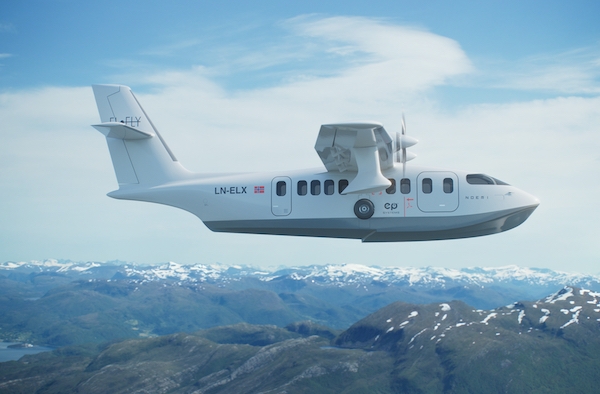
Today in Oslo, Elfly Group presented its new design of its pure, all-electric commercial seaplane NoEmi (for No Emission). A 100-strong audience experienced a full-scale cabin virtual reality tour of this innovative amphibious aircraft. Noemi is being designed for flexible mobility in Norway with a design inspired by a boat, whose hull will enable the aircraft to take off using little power. The prototype (non-passenger version) of NoEmi is being readied for flight in 2025. Elfly is being designed for 200km air journeys, flying at up to 250kmh speed, from Year 2030. The seaplane, with a non-pressurised cabin, will be powered by two electric motors with up to 1MW combined output.
Elfly’s design is part of a research project, funded by private investors and the Research Council of Norway .The group is working to obtain certification for its EG1A test vehicle to CS23 Level 4, which will enable the aircraft to evolve up to a 19-seat seaplane. Noemi, however, is being offered in three cabin layouts. First and foremost, as a business/executive cabin with nine seats, plus luggage; complemented by a VIP layout with six seats, wherein the whole aircraft could be chartered. A tourist pleasure flight model with 13 seats, minus baggage, will also be offered. In a nod to its flexible functionality, a cargo version is also planned, plus a medevac version.

Elfly to obtain AOC to fly the aircraft
Unlike other electric aircraft developers, Elfly intends to pursue an operator's certificate and bring the first aircraft into service, initially connecting the fjords of Norway. The desire is to have the first 15 seaplanes flying along the west coast of Norway by 2030.
Eric Lithun, CEO of Elfly commented: “Thereafter, we could expand into other short hop markets, considering that 80% of the world's population live by the sea.Our goal is to bring innovation to the whole supply chain and make the process as seamless as possible.
The Noemi is a modern-day amphibious aircraft with lithium batteries and an electric engine, inspired by the venerable de Havilland Twin Otter and Grumman’s Mallard - “two great flying machines,” highlights Eric. Noemi will feature a large cargo door and its cabin will be fully accessible for wheelchair users.
With the world focused on sustainability and the environment (Norway has pledged to be all-electric in 2040; Denmark and Sweden a decade earlier) we see wider opportunities with the creation of affordable sea terminals, versus complex infrastructure, he added.
Norway is ideally located to pioneer next-gen, environmentally friendly seaplanes, with more than 1,000 fjords and 450,000 lakes. Potential routes include Bergen to Stavanger, used by 550,000 passengers annually. Some 500,000 travel by bus (a three-hour journey) 70,000 by ferry. Noemi would cut journey time to under an hour.

Elfly will be at Paris Air Show next week where it plans to disclose new partners/suppliers on the project.
Archived
2 years ago
Bombardier Defense will provide three Global 6500 aircraft to fly maritime surveillance missions for the Australian Border Force. Metrea - the originator and leading provider...
Air passenger rights in Europe are at a critical crossroads. On June 2, the European Union’s Conciliation Committee will meet for a final round of negotiations on the revision of the European re...
AERO 2027, taking place from April 14-17, 2027, will feature a further developed concept designed to build on the great success of this year’s event. In 2026, 860 exhibitors from 50 countries to...
The A350-1000ULR (MSN 707), the first of 12 aircraft ordered by Qantas has completed its first flight in Toulouse, France. The aircraft, fitted with special flight test instrumentation, flew for three...