


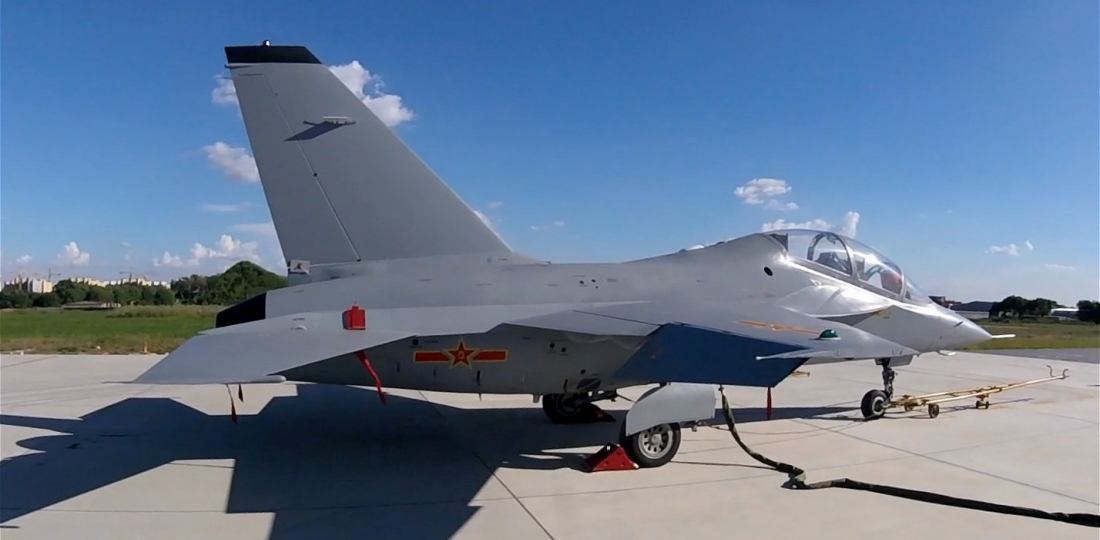
Photos emerging from China have suggested that the People’s Liberation Army Air Force (PLAAF) has taken delivery of the first Hongdu L-15 jet trainer. The supersonic, twin-engine, twin-seat trainer is among a variety ofPLAAF aircraft that will be taking part at an open day at Changchun Airbase, Jilin Province in northeastern China from September 1 to 4.
This is the first time the L-15, reportedly designated JL-10 in PLAAF service, has been seen in PLAAF colors, although it is not clear which unit the type has been assigned to.
Analysts expect the PLAAF will use the JL-10 as a lead-in fighter trainer (LIFT) or a light attack aircraft, while advanced jet training will be conducted using the lower-performance Guizhou JL-9, which is currently in service with the PLAAF and the People’s Liberation Army Naval Air Force. The JL-10 will be a lower-cost option to transition pilots into fighters such as the Chengdu J-10 or Shenyang J-11.
The L-15 made its first flight in 2006, with development reportedly assisted by Russia's Yakovlev Experimental Design Bureau. According to the manufacturer, the L-15/JL-10 can be configured as an advanced jet trainer or as a LIFT aircraft, with the LIFT variant capable of carrying a range of weaponry including the PL-8 air-to-air missile and LS-6 satellite guided bombs.
Hongdu has also said the type features a digital fly-by-wire control system with a glass cockpit and integrated avionics. The LIFT variant is equipped with a locally developed passive electronically scanned array radar.
The L-15/JL-10 is powered by the Ukrainian Ivchenko Progress AI-222K turbofan; the LIFT variant uses the afterburning AI-222K-25F model. China is believed to be developing an indigenous engine to power the aircraft, reportedly designated the WS-17.
China’s well-known inability to produce aircraft engines of sufficient quality is part of the reason why it has set up a new company to oversee civil and military aircraft engine development and production efforts. The Aero Engine Corporation of China (AECC) incorporates subsidiaries of a series of state-owned firms, including the Aviation Industrial Corp. of China (AVIC).
With a registered capital of 50 billion RMB ($7.5 billion) and a workforce of 96,000, the group’s formation has been described by Chinese President Xi Jinping as a “strategic move” to make China an aviation power and modernise the military, according to China’s state news agency Xinhua.
Affirming Cathay’ ongoing commitment to growing Hong Kong’s connectivity with Belt and Road countries, Cathay Pacific is pleased to announce plans to launch direct flights to Almaty,...
U.S.-based aircraft management, fractional ownership, jet cards, and charter services operator Airshare is equipping its fleet of Embraer Phenom 300s with the Gogo Galileo HDX system. The up...
Cirrus launched Let’s Go Fly!, a first-of-its-kind app created for Apple Vision Pro that delivers an immersive introduction to Personal Aviation—the freedom, convenience and acce...
Kansai International airport (KIX) reaches new milestone in its development with the inauguration of the completed international trade zone. This completion marks the conclusion of the extensive renov...