


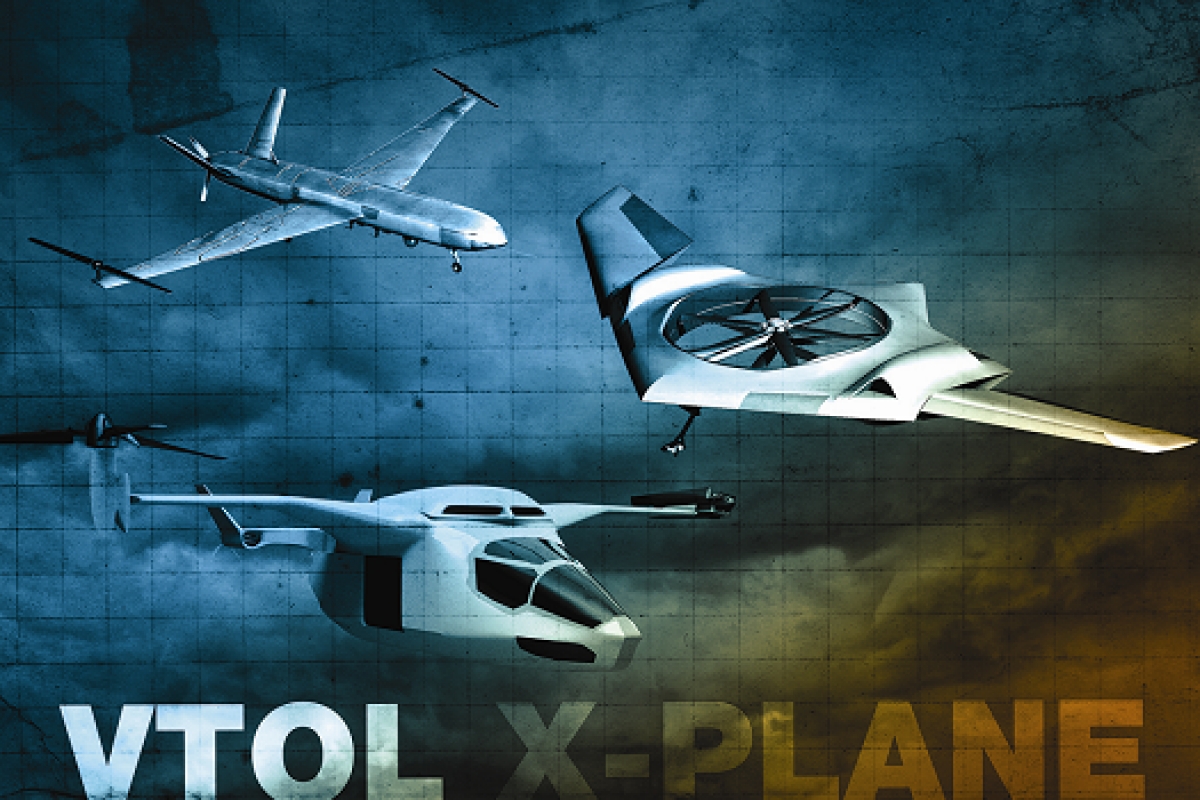
What takes off like a helicopter, flies like a plane, and looks like something Orville Wright might dream up on mescaline? The military’s next X-Plane! On Thursday, aircraft maker Aurora Flight Sciences announced that its LightningStrike design had received the prime contract to continue the development of the VTOL X-Plane project. (VTOL stands for vertical takeoff and/or landing.)
The Defense Advanced Research Projects Agency, or DARPA, first announced the VTOL program back in 2013. The goal: radically improved helicopter technology that could carry about 4,000 pounds (40 percent of the vehicle’s weight) at speeds over 300 knots. (For context, the F-35 was designed for a top speed of 1,066 knots.) The original broad agency announcement, or BAA, called for some $130 million in research and development over three phases.
But why does the military need a new helicopter plane when it already has the Boeing V-22 Osprey? To cite the BAA: the program is a technology demonstrator and “not intended to create a pre-production type aircraft for any specific operational effort.” Rather, the goal is broad technological improvements in helicopter and vertical lift tech.
Vertical-lift craft like the Osprey use big open rotors because you can get more lift straight up at less power. But even with large rotators, VTOLs are only about 60% as efficient as they could be. And the status quo has a downside, literally, in the form of bad lift-to-drag ratio, which is the amount of lift an aircraft generates divided by the amount of aerodynamic drag. The better the ratio, the less energy the aircraft will burn taking off and the better it will fly. Fixed-wing aircraft have a lift-to-drag ratio that’s two to three times better than typical vertical-lift aircraft, according to the BAA.
But shrinking the rotors means you have to add power. Just ask Paul Moller, inventor of the Moller M400 Skycar, basically a VTOL for regular folks with four rotor pods arrayed around a passenger capsule. The blades would move the car up vertically and then tilt to propel it through the air. Moeller was able to successfully demonstrate it several times, but the amount of energy needed to move the fans is, basically, the reason you can’t have a flying car, today.
“Once you reduce the diameter of the propulsion system” — that is, shrink the size of the propellers — “you go from a helicopter to a fan system. So you’re moving less air, and the less air you move, the more power it takes to generate a certain kind of thrust. If I took a helicopter and made it one-half the diameter, I would have to immediately add 60% more power. I halve the diameter again, I have to add 60% more power, again,” he told The Futurist magazine back in 2008.
Aurora’s design uses 24 ducted fans on the wings and the tail or canards. A Rolls-Royce AE 1107C turboshaft engine feeds power to three Honeywell generators, which run the propellers’ motors.
Phase II of the program comes next and “will focus on the detailed design, development, fabrication and testing of the subsystem technologies for integration on the aircraft,” the BAA said. “Fabrication of the two air vehicles will also commence during this phase with the first aircraft completed prior to Phase III.”
If the tests are successful, the military will have an actual aircraft and a much better idea how to create helicopter planes by the time the program conducts live tests in 2018.
No date yet on your flying car.
AERO 2027, taking place from April 14-17, 2027, will feature a further developed concept designed to build on the great success of this year’s event. In 2026, 860 exhibitors from 50 countries to...
Lufthansa is focusing more than ever on premium service: Following the introduction of the new in-flight service on all long-haul flights in early May, the number of destinations where passengers can...
While the geopolitical situation contributed to economic uncertainty in Q1, market fundamentals remained healthy. The quarter showed strong demand for business aviation, reflected in increasing aircra...
Baltic Ground Services, an international provider of ground handling and aircraft fueling services, has expanded its cooperation with Turkish leisure carrier Freebird Airlines across several airports...