


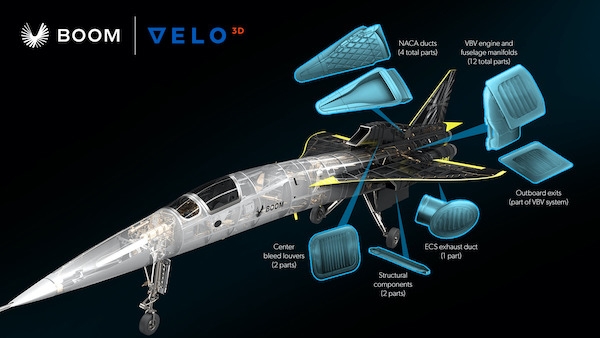
VELO3D announced that Boom Supersonic XB-1 aircraft includes 21 flight hardware components that were manufactured by VELO3D’s Sapphire 3D metal printer. Unveiled at Boom’s hangar in Centennial, Colorado, XB-1 marks a turning point in commercial viability for supersonic travel and demonstrates the power of additive manufacturing, or 3D printing, to enable innovation while accelerating product development.
“Aviation hardware is especially difficult to manufacture with 3D metal printing, due to challenging aerodynamic designs that must be balanced with superior durability and high temperature requirements,” said Benny Buller, CEO and Founder of VELO3D. “VELO3D’s technology allows the production of lightweight, complex designs for mission-critical applications in the toughest operating conditions. Our partnership with Boom is truly an advancement for the metal AM industry, and XB-1 supersonic aircraft is a game-changer for the aviation industry.”
Boom Supersonic and VELO3D announced a partnership in 2019 to manufacture complex flight hardware to build XB-1, and ran a series of qualification trials on VELO3D Saphire system. The printed Titanium parts are used for engine hardware, the environmental control system, and structural components. Characteristics of the geometric designs include tall, thin walls with high aspect ratios, which are inherently difficult to manufacture with either traditional processes such as welding and casting, or even most existing 3D-printing technologies. VELO3D’s unique SupportFree printing process enables unprecedented design freedom and quality control, eliminating manufacturing constraints to innovation in aircraft design.
"We strongly believe that supersonic is the future of flight and we’re appreciative of VELO3D in helping us to realize this goal with XB-1," states Mike Jagemann, Head of XB-1 Production at Boom Supersonic.
XB-1 is the world’s first independently developed supersonic jet. It will be used to demonstrate critical technologies for Overture, Boom’s future commercial airliner, such as advanced carbon-fiber composite construction, computer-optimized high-efficiency aerodynamics, and an efficient supersonic propulsion system. XB-1 is the end-product of years of development effort, including multiple wind tunnel trials, dozens of structural tests, hundreds of simulation iterations, and tens of thousands of work hours.
Azerbaijan Airlines expanded its fleet with another state-of-the-art Airbus A320neo aircraft. The introduction of the new aircraft is aimed at providing passengers with more comfortable and moder...
Embraer and OGMA have successfully completed the first scheduled 24- month maintenance of a C-390 Millennium aircraft operated by the Hungarian Air Force. The work was carried out at OGMA’s faci...
Airmedic unveiled a new medical cabin purpose-built for its Bombardier Learjet 45XR aircraft. Already in service aboard the first aircraft, this permanent clinical environment supports patient tr...
flydubai announced that applications are now open for its newly launched Flight Dispatcher Programme for Emirati talent. Following the MoU signed earlier this year with Emirates Aviation University, t...