


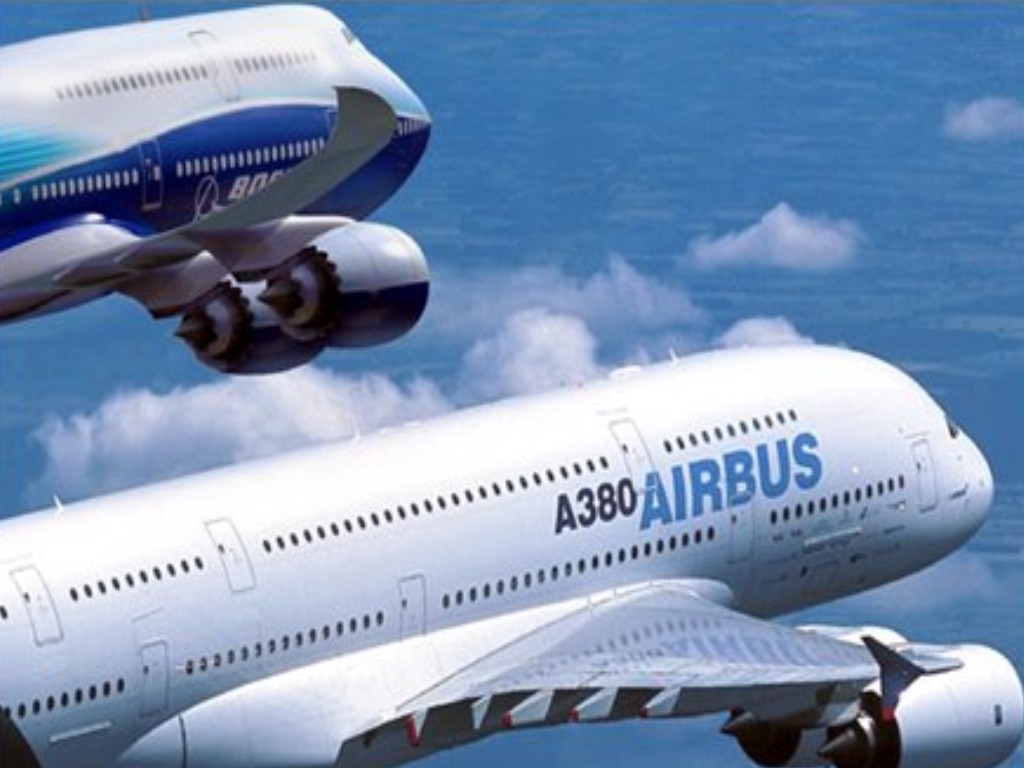
Boeing Co and Airbus remain confident about strong demand from Indian Airlines, which is expected to order 1,740 jets in the next two decades. Both of the companies believe that increased demand from the world’s fastest-growing aviation market is likely to offset the overall decline in sales.
By the end of fiscal year 2034, India is expected to place orders worth $240 billion. Improved airport infrastructure in India, along with a slump in oil prices are the two main factors attributed to the increased expected demand. Improved earnings per capita have made air travel more affordable for a larger segment of the Indian population – another significant demand driver.
During the Indian Aviation airshow held in the southern city of Hyderabad in India, Airbus Group SE stated that India will require above 1,600 passenger and freighter jets, in the next 20 years. On the back of a strong relationship with India’s SpiceJet Airlines, the European aircraft manufacturer remains confident about its market share in India.
With an order for 250 A320neo from IndiGo airlines, we believe Airbus’ confidence has some basis to it. Another upcoming order from SpiceJet for a 100 single aisle jets worth $11 billion, can give Airbus an edge over Boeing, if the latter is not awarded the contract.
Tough competition in Asia-Pacific region
Boeing and Airbus are so far, head to head in terms of the market share, in the Asia-Pacific region. Along with India, a healthy demand for single aisle commercial jets is expected from China.
During the fourth quarter of 2015, Boeing signed an agreement with China, to set up its aircraft completion facility in China. Keeping up with its rival, Airbus also announced its plans to set up its A330 aircraft completion facility in China, to cater to the wide-body aircraft demand in the region.
Only Focused on single-aisle aircraft
Both of the companies seem to be focused on smaller single-aisle commercial jets, which have the highest demand in the world. The wide-body jets’ demand seems to be low for both aircraft manufactures.
While Airbus has not shown inclination to introduce the revamped version of its A380 superjumbo jet despite demand from Emirates, Boeing has begun consolidation of its 747 and 767 aircraft as cost reduction effort.
Of late, talks about creating a middle-of-the-market aircraft have surfaced; however, a concrete decision on the matter is yet to be made by any of the industry players. Industry analysts believe that the unfilled gap, for middle-of-the-market aircraft, is likely to lead to larger opportunities for aircraft manufacturers. Boeing, however, announced earlier this month that the prospect poses a “tough market case.”
Cirrus launched Let’s Go Fly!, a first-of-its-kind app created for Apple Vision Pro that delivers an immersive introduction to Personal Aviation—the freedom, convenience and acce...
Lufthansa is focusing more than ever on premium service: Following the introduction of the new in-flight service on all long-haul flights in early May, the number of destinations where passengers can...
The A350-1000ULR (MSN 707), the first of 12 aircraft ordered by Qantas has completed its first flight in Toulouse, France. The aircraft, fitted with special flight test instrumentation, flew for three...
Kansai International airport (KIX) reaches new milestone in its development with the inauguration of the completed international trade zone. This completion marks the conclusion of the extensive renov...