


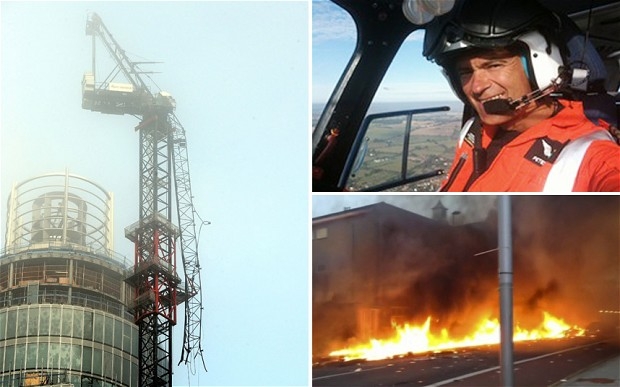
Peter Barnes made inappropriate decision to fly in 'excessively challenging weather' while under pressure to satisfy important client, jury decides.
A pilot who was killed in a central London helicopter crash was under commercial pressure to satisfy an important client when he made the inappropriate and unsafe decision to fly in "excessively challenging weather conditions", a jury has found.
Peter Barnes, 50, died when the helicopter he was piloting clipped a crane at The Tower, St George Wharf, Vauxhall, in January 2013.
Pedestrian Matthew Wood, 39, from Sutton, Surrey, was also killed as he walked to work. Twelve other people on the ground were injured.

Another man was also killed when helicopter pilot Peter Barnes crashed
The jury on Friday delivered its conclusions about both deaths before coroner, Dr Andrew Harris.
It found both deaths were accidental, however Mr Barnes's decision to fly despite the freezing fog and scattered cloud that morning was "neither safe nor appropriate".
Mr Barnes, a pilot 24 years, had been working for the helicopter company RotorMotion, which is no longer in business.
He had been flying from Redhill Aerodrome in Surrey to Elstree in Hertfordshire but was diverted to Battersea heliport.
The jury accepted evidence from Air Accidents Investigation Branch (AAIB) inspector Geraint Herbert, who believed Mr Barnes suffered a "Loss of situation awareness" due to poor visibility, causing his accident.
The jury noted that the pilot's decision to take off from Redhill was technically "safe" as the weather there had cleared, but inappropriate.
Jurors concluded: "He could not have reasonably expected to have completed his planned flight while maintaining adequate visibility. Therefore, he should not have attempted the flight."
The jury found Mr Barnes's decision to divert to Battersea, after receiving a text message from a client, was also unsafe and inappropriate.
Jurors concluded: "Mr Barnes was likely to have felt under pressure to land at Battersea."

Peter Barnes was a pilot with 24 years' experience Photo: ROSSPARRY
They added: "The 7.55am text message he received from a client prompted his decision to divert, and was likely to have been read as the landing preference of a significant client, regardless of intention.
"The general commercial pressure within a small company to keep such a client happy may have been exacerbated by that client's disagreement with another pilot there a fortnight earlier and an investigation into a third pilot."
The jury found that Mr Barnes should have aborted the Battersea landing. But it said there could be no certainty about whether Mr Barnes became distracted immediately before he crashed.
"Timing suggests he may have been changing the frequency on his radio," the jury concluded. "However Mr Barnes was a highly experienced pilot unlikely to become distracted by communication, ahead of aviation and navigation."
Which strategy leads to cost-effective, climate-friendly aviation in 2070? Four scenarios from the Bauhaus Luftfahrt think tank illustrate the impacts of different transformation paths. Key points: In...
dnata has secured a new multi-year contract with Silk Way Group to provide cargo and freighter handling services at Singapore Changi Airport (SIN), further strengthening a longstanding global par...
Air passenger rights in Europe are at a critical crossroads. On June 2, the European Union’s Conciliation Committee will meet for a final round of negotiations on the revision of the European re...
ExecuJet MRO Services Australasia is expanding its Falcon maintenance capability in Sydney, with new investments in specialist tooling, training and technical resources to support upcoming Falcon 7X h...