


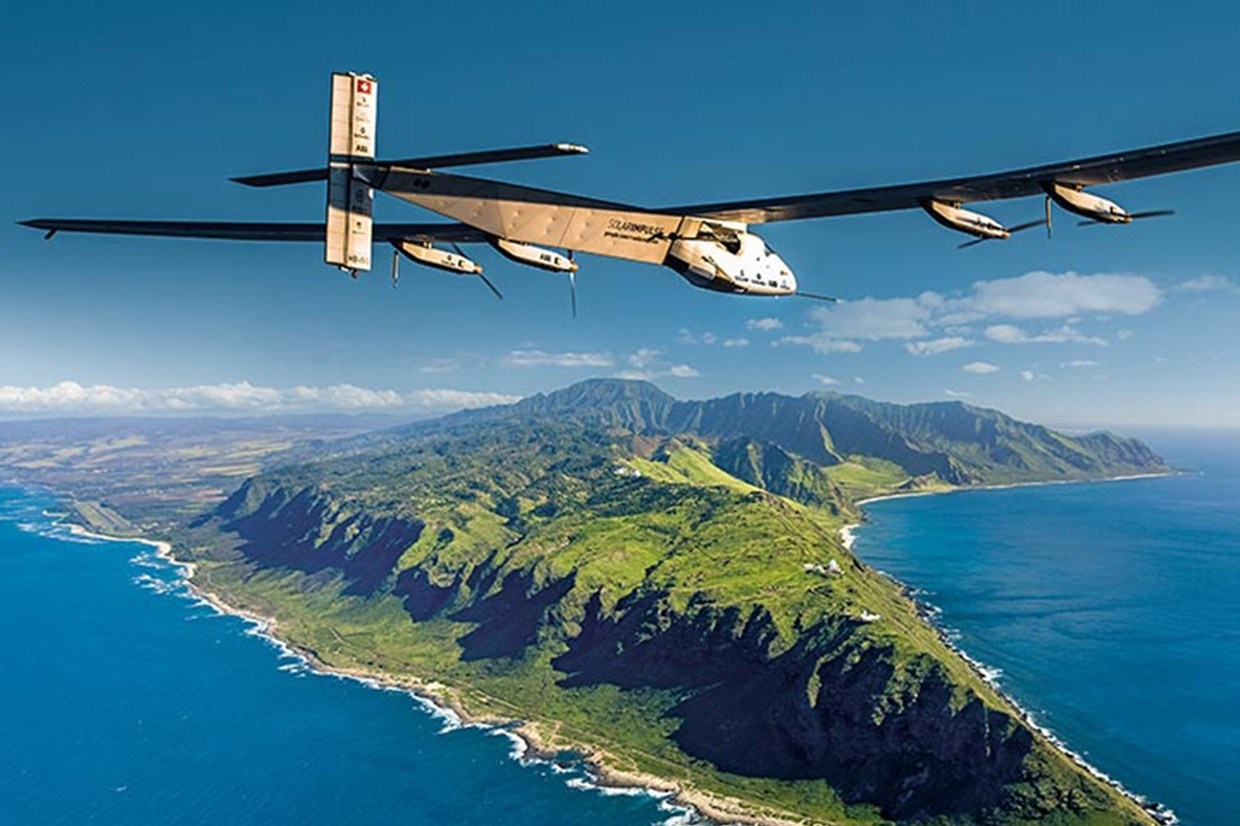
This week at the United Nations Climate Summit in Paris, Solar Impulse founders Andre Borschberg and Bertrand Piccard announced the Solar Impulse 2 (SI2) will resume its around the world mission next April, after receiving additional funding and repairs.
SI2 began its journey in March, taking off from Abu Dhabi, and making stops in Oman, Ahmedabad, Varanasi, Mandalay, Chongqing, Nanjing, Nagoya and Honolulu. The journey had already been delayed by fog before a forced landing in Nagoya, due to wing damage caused by high winds aloft.
From Nagoya, Si2 departed for Honolulu. After reaching the city on July 3, it was discovered the batteries, which store the solar energy, had overheated during the flight - causing irreversible damage. At that point, the Solar Impulse team estimated the repair would take several weeks.
Andre Borschberg, the 62-year-old pilot told CNN, "There are chances that we can make it. But there are risks also that we can't make it on time ... We ate our margin."
After the battery debacle, the team called it quits for the year on July 15. Even if they had been able to complete repairs, they were concerned about the lack of daytime sunshine in the Northern Hemisphere during the fall and winter, and its ability to charge the plane's batteries.
What's so special about Solar Impulse? First off, it's not so much an aviation technology demonstrator as it is an energy technology demonstrator. The primary goal is to trumpet the importance of clean energy. Solar Impulse has the wingspan of a Boeing 747, and nearly every available inch is covered with 17,248 solar cells. The plane can fly 24/7 thanks to the ability to store solar energy in batteries. The aircraft weighs about as much as the average family sedan, which is a remarkable feat itself.
Even more amazing is the fact that Solar Impulse is flown by only one pilot, for up to five straight days, in an unheated and unpressurized cockpit.
The plane requires an ascent to 28,000 feet to fully charge its batteries, so the pilots have to wear an oxygen mask while at that altitude. It's not only an incredible plane, but the trip is also amazing as a feat of human endurance. They're only allowed to take short naps of up to 20 minutes. The pilots use meditation and hypnosis to help them relax and fall asleep quickly.
The food they eat while flying is much like astronaut food, either vacuum-sealed or freeze-dried. And in case you're wondering, the toilet is built right into the pilot's seat.
In April, SI2 is slated to fly 2,500 miles nonstop from Honolulu to Phoenix, which is a long flight even for a commercial jet at Mach .85 - but SI2 flies at car speeds.
The project had roots dating as far back as 1999, following an around-the-world balloon flight by Borschberg. I was at DFW Airport in Fort Worth when Borschberg landed the prototype Solar Impulse plane at the end of a record-setting flight from Phoenix, and hope to be onsite when SI2 makes a stop in the U.S. We will keep you posted on all of the latest news and events related to this incredible plane.
The A350-1000ULR (MSN 707), the first of 12 aircraft ordered by Qantas has completed its first flight in Toulouse, France. The aircraft, fitted with special flight test instrumentation, flew for three...
Liebherr-Aerospace and Loong Air launched a long-term collaboration, with Liebherr-Aerospace providing major repair and re-coring services for the heat transfer equipment on Loong Air’s A320ceo/...
Bell Textron announced the order of the first Bell 407GXi helicopter in India to TransBharat Aviation Private Limited, one of India’s most established non-scheduled rotary-wing operators. F...
dnata has secured a new multi-year contract with Silk Way Group to provide cargo and freighter handling services at Singapore Changi Airport (SIN), further strengthening a longstanding global par...