


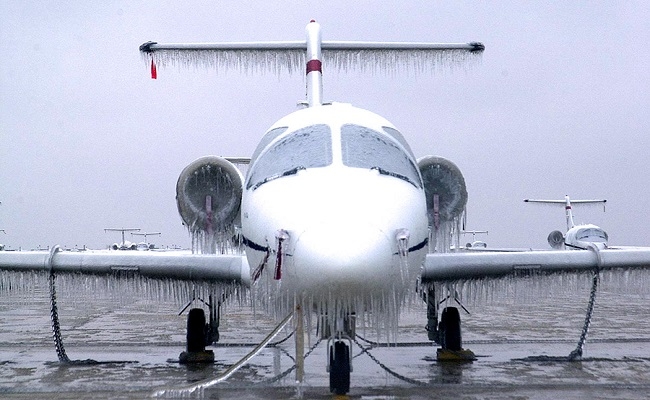
Scientists develop ice-repellent coating for airplanes and windshields – Researchers from the University of Michigan have developed a spray-on coating that can make theice slide off from a large amount of commercial equipment like airplanes and car windshields, with nothing but the force of gravity.
The new finding could have major implications in industries like energy, shipping, and transportation, where the ice is a serious problem during cold climates and can affect some business, according to EurekAlert.
Energy savings may come from the coating due to the large amount of energy that requires freezers to defrost. The ice-repelling tool could do the same job with zero energy consumption, which makes household and industrial freezers up to 20 percent more efficient.
“Researchers had been trying for years to dial down ice adhesion strength with chemistry, making more and more water-repellent surfaces,” said Kevin Golovin, a doctoral student in materials science and engineering, in a statement. “We have discovered a new knob to turn, using physics to change the mechanics of how ice breaks free from a surface,” he added.
Nobody had explored the idea that rubberiness can reduce ice adhesion, the study lead Anish Tuteja said. Like ice is frozen water, people assumed that ice-repelling surfaces had to also repel water, which was not the case, Tuteja added.
The new method is more durable than the previously established repellents, which are said to be less effective and more pricey. Scientists said that the new coating was able to stand up against various lab test including peel test, corrosion test and exposure to high temperature, as reported by UPI.
VARIETY OF APPLICATIONS
It was also found by the research team that alterations of the smoothness and rubberiness of the coating can fine-tune its degree of ice repellency and durability. For instance, softer surfaces tend to be more ice-repellent but less durable, while the opposite is true for harder coatings.
The flexibility, according to the team, can enable them to create coating specialized for a variety of applications. An airplane coating would need to be extremely durable but this could make it less ice-repellent due to the high winds and vibrations that would help push ice off, Golovin said.
In the other hand, a freezer coating could be less durable but would need to shed ice with just the force of gravity and slight vibrations. The positive thing about their approach, Golovin commented, is that it is easy to fine-tune it for any given application.
Affirming Cathay’ ongoing commitment to growing Hong Kong’s connectivity with Belt and Road countries, Cathay Pacific is pleased to announce plans to launch direct flights to Almaty,...
Bombardier Defense will provide three Global 6500 aircraft to fly maritime surveillance missions for the Australian Border Force. Metrea - the originator and leading provider...
The A350-1000ULR (MSN 707), the first of 12 aircraft ordered by Qantas has completed its first flight in Toulouse, France. The aircraft, fitted with special flight test instrumentation, flew for three...
Bell Textron announced the order of the first Bell 407GXi helicopter in India to TransBharat Aviation Private Limited, one of India’s most established non-scheduled rotary-wing operators. F...