


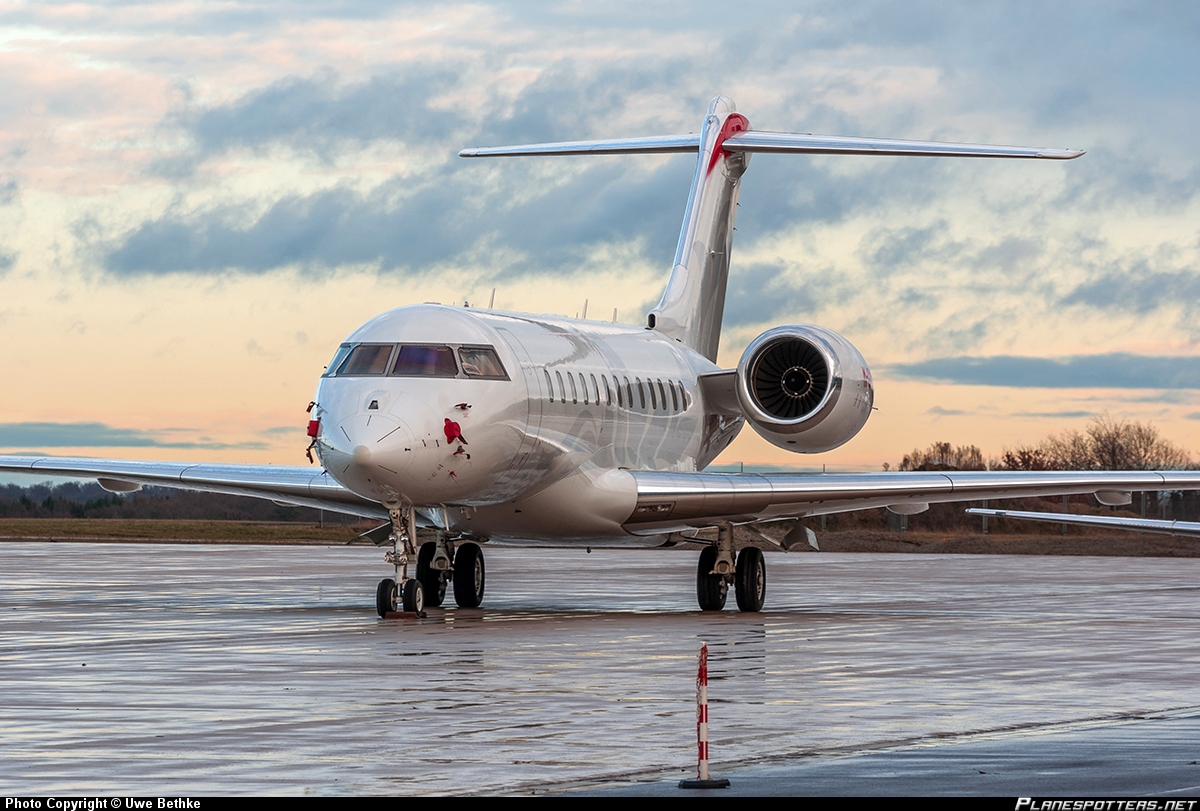
Bombardier threw down the gauntlet in front of Gulfstream when it announced the Global Express in December 1993, officially launching the battle between Montreal and Savannah for King of the Heavy-Iron class. With the aircraft’s super lean 46,500-lb. BOW, 41,500 lb. of fuel and 91,000-lb. MTOW, Bombardier officials boasted that the clean-sheet flagship would fly faster, farther and more efficiently than Gulfstream’s derivative GV. Montreal predicted it would fly 6,330 nm at Mach 0.85 and 6,500 nm at Mach 0.85.
But then the Global’s green weight ballooned during development and customers loaded it up with extras during completion. As empty aircraft weight went up, MTOW had to be increased from 91,000 lb. to 93,500 lb. Fuel capacity was increased by 1,569 lb. to 43,069 lb. in an attempt to preserve range. But then tanks-full payload evaporated.
To compensate, Bombardier developed a series of optional weight increase service bulletins that hefted it to 95,000 lb. (SB 700-11-007), then 96,000 lb. (SB 700-11-011), then 98,000 lb. (SB 700-11-016) and finally 99,500 lb. (SB 700-11-020). The penalties for the weight hikes were increased required runway lengths, poorer climb performance, lower initial cruise altitudes and decreased range. However, MTOW is restricted to 94,513 lb. when departing BCA’s 5,000 ft. elevation/ISA+20C airport because of OEI second segment climb requirements.

Yet, the aircraft still provides intercontinental range. Operators say the Global Express can comfortably fly 11 hr. at Mach 0.85 or 5,300 nm. They’ll push missions to 12 hr. or 5,800 nm, if the destination weather is good and there are multiple suitable alternate airports. The aircraft will climb directly to FL 390 or FL 400, depending upon OAT. For simple flight planning, first, second and third and subsequent hour fuel flows are 5,000, 4,000 and 3,000 lb., respectively.
The Global Express had a rocky entry into service in 1999 with numerous breakdowns. Even worse, operators said Bombardier’s product support then was lacking. But now it has evolved into a highly reliable business tool and operators say Bombardier has stepped up its technical and parts support.
Pilots like the aircraft’s systems redundancy, soft control feel, ride quality, short runway performance on medium-length trips, cockpit and cabin comfort and very low cabin noise levels. They also say the systems are automated, checklists are short and it’s mostly a modern aircraft, including its auto-brake system, electronic circuit breakers and comprehensive systems monitoring box.
The aircraft’s original Honeywell Primus 2000XP avionics suite, with its six 8-in. x 7-in., DU870 displays, is dated. A DU875 flat-panel screen six-pack Primus Elite upgrade is available for $750,000, but its features, such as e-charts, are not well integrated. Bombardier’s Batch 3 upgrade is highly desirable as it improves FMS, flight guidance computer and display performance. Batch 3 also paves the way for SBAS/LPV approach, FANS1/A and ADS-B options.
The autothrottles are responsive, but they’re a little twitchy for best fuel efficiency during cruise. Pilots say it’s best to disconnect them at altitude and just set fuel flow.
When starting the aircraft, pilots must be patient. After switching on the batteries, it takes three to four minutes for all DC built-in tests to be automatically completed. Then, once the APU is started, it takes five to eight minutes for the AC BIT checks to run. And finally, the Honeywell/Baker cabin management system may be switched on, including galley power. Rush the process and you may encounter a systems glitch that requires the whole electrical system to be shut down and restarted.
Most operators have enrolled their aircraft’s 14,750-lb. thrust BR710 turbofans in Rolls-Royce Corporate Care. Many operators say rates range from $900 to $1,000 per hour for both engines. Most also enroll in Bombardier’s Smart Parts maintenance program, which also runs $800 to $900 per hour.
Basic maintenance intervals are 15 months and 750 hr. Landing gear overhaul is due at 120 months. It runs about $280,000, if the aircraft is enrolled in Smart Parts. Watch out for corrosion during the 120-month inspection. Repairs can run $500,000 to $1.5 million.
Bombardier built 146 Global Expresses before the model was succeeded by the Global XRS in early 2005. Prices range from $12 million for early 1999 models to $18 million for later models.
The Gulfstream V is the Global’s main competitor. It’s similarly priced and it offers more range, higher cruise altitudes and better fuel efficiency, but a smaller cabin, a stiffer ride and slower cruise speeds.
The ready availability of second generation Global XRS and Gulfstream G550 aircraft is putting downward pressure on asking prices for the Global Express and GV. That makes the original Global more of a bargain. It’s capable of the same 5,300 nm to 5,800 nm missions of new large-cabin competitors that cost up to three times as much, so it can dash non-stop between North America and Europe, or between North America and Asia with one stop. Built for comfort as well as cruise speed, the Global Express’s cabin volume, interior sound levels and ride quality are unmatched by anything in its price class.


Affirming Cathay’ ongoing commitment to growing Hong Kong’s connectivity with Belt and Road countries, Cathay Pacific is pleased to announce plans to launch direct flights to Almaty,...
For more than twenty-five years, Jetfly has been developing its Shared Ownership Program, focusing in particular on the Pilatus PC-12, a turboprop aircraft renowned for its versatility, reliability, a...
The A350-1000ULR (MSN 707), the first of 12 aircraft ordered by Qantas has completed its first flight in Toulouse, France. The aircraft, fitted with special flight test instrumentation, flew for three...
Liebherr-Aerospace and Loong Air launched a long-term collaboration, with Liebherr-Aerospace providing major repair and re-coring services for the heat transfer equipment on Loong Air’s A320ceo/...