



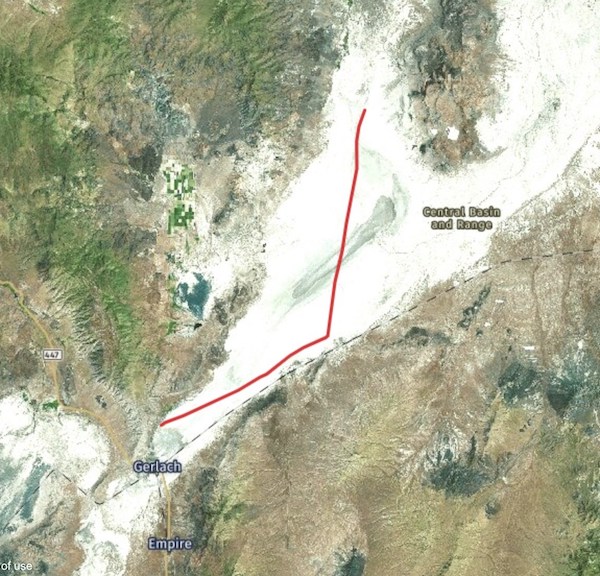
Impossible Aerospace announced that its US-1 "flying battery" quadcopter became the first aircraft of its kind to cross the northern Nevada desert without recharging in repeated 72-minute flights across the playa on August 6, 2019.
This flight marked yet another public demonstration for the US-1, first unveiled at Interdrone 2018. The aircraft used for the flight was an unmodified production US-1, carrying with it both a FLIR Duo Pro R camera and HD video transmitter. With and against the prevailing winds, the US-1 flew distances of 29 and 21 miles respectively.
"The US-1 is the first major breakthrough in drone performance since the introduction of the quadcopter," said Spencer Gore, CEO. "More importantly, is the first battery-electric aircraft to rival the performance of a conventionally powered system."
While many electric aircraft have flown similar distances, the US-1 differs in that it uses propellers instead of wings to fight gravity, which requires more energy per mile but allows the aircraft to hover in place.
The US-1 has seen strong commercial traction with government and enterprise customers. On August 5th, the city of San Pablo, California announced it would be purchasing three US-1 aircraft for use by its police department, and on August 13, gas detection company SeekOps announced it would integrate with US-1.
According to the company, the flight was planned to avoid operations over people and protected wilderness areas. The flight was conducted under 14 CFR 107.25, with the pilot operating as a passenger of a moving vehicle over a sparsely populated area maintaining visual line of sight to the aircraft.
"The ultimate vision of Impossible Aerospace is to build long-range electric aircraft that carry goods and people around the world, emissions free," said Gore. "But electrification changes literally everything about an aircraft, and many of these changes will take years to prove safe enough for passenger transport. In the meantime, we believe it's prudent to push the envelope of electric aircraft using unmanned aircraft, and to advance drone regulations by piloting use cases that save lives."


Liebherr-Aerospace and Loong Air launched a long-term collaboration, with Liebherr-Aerospace providing major repair and re-coring services for the heat transfer equipment on Loong Air’s A320ceo/...
AIR announced a strategic partnership with Dynon Avionics as its exclusive avionics provider across its aircraft portfolio. The portfolio includes the AIR ONE personal eVTOL and the company&...
Which strategy leads to cost-effective, climate-friendly aviation in 2070? Four scenarios from the Bauhaus Luftfahrt think tank illustrate the impacts of different transformation paths. Key points: In...
The European tour of Daher Aircraft’s “go-anywhere” Kodiak 900 multi-role airplane continues this week at the France Air Expo 2026 event in Lyon, France, where it will join a fast, e...