


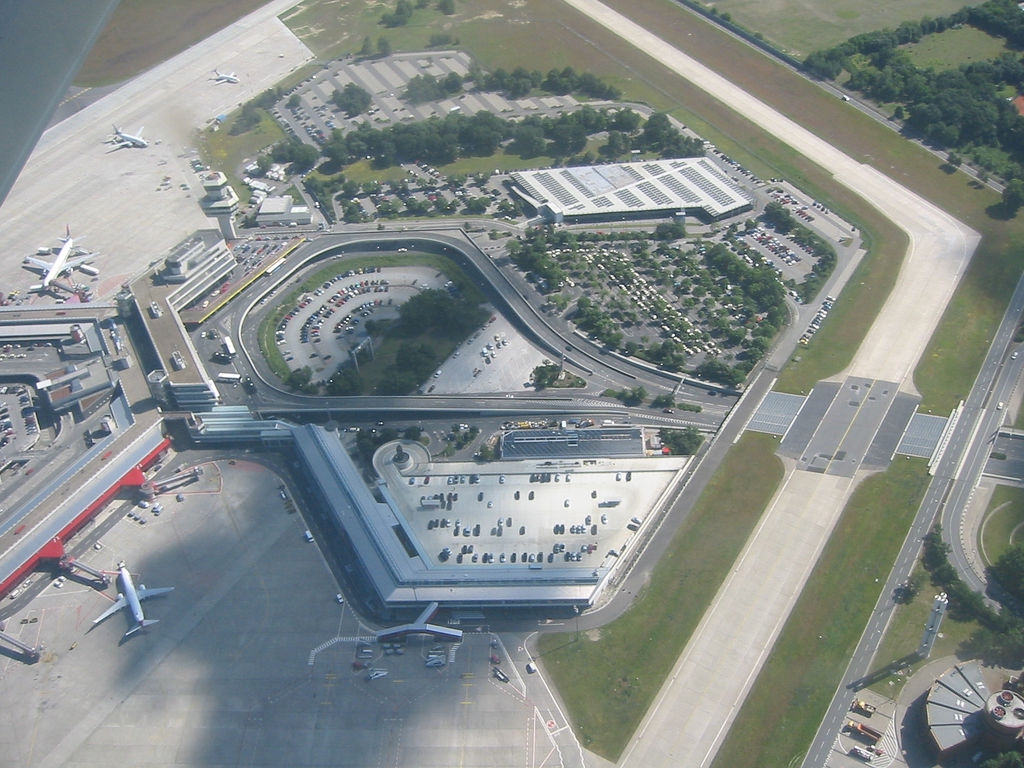

Built in the 1970s, Berlin's Tegel airport should have closed years ago, but embarrassing delays to the city's new airport have forced its owners to resort to stop-gap measures to keep it going.
Originally meant to serve around 6 million passengers when the main terminal building opened in 1974, Tegel now handles over 20 million a year, and the only way it can take more is if airlines use larger planes.
A lack of investment over the last few years while awaiting the opening of the new Berlin Brandenburg airport means Tegel is now bursting at the seams.
Its concrete architecture contrasts sharply with the steel and glass structures of modern hubs in London, Frankfurt and Paris. Long queues for security checks and restrooms are commonplace.
But many still appreciate Tegel because it is just 8 km (5 miles) from central Berlin and a public transport ticket to get there costs only EUR€2.70 (USD$3.05).
Tegel dates back to 1948, when an airport was built in just 90 days to support the Berlin Airlift, a huge Western operation to ship in supplies and thwart a Soviet blockade of West Berlin.
It was meant to close around 2012, replaced by a new international hub to the southeast of Berlin next to the existing Schönefeld airport.
But building problems have repeatedly delayed the new airport. In 2012, the opening had to be called off just three weeks before airlines were due to move in.
Questions have already been raised over the new target date in the second half of 2017 after one of the contractors declared insolvency over the summer.
KEEP TEGEL OPEN?
To keep Tegel running smoothly until the new airport opens, its government owners are investing a further EUR€19 million (USD$21.5 million) in 2015 and 2016.
The funds are being used for, among other things, a new anti-skid coating on the south runway, improved bathroom facilities, and replacement of a 40-year-old water tank for the sprinkler system.
Airport officials say the latest investment should suffice until Berlin Brandenburg is opened, but some feel Tegel should be allowed to keep going, rather than being closed.
Fans note the new airport will have a capacity of 27 million, fewer than the 28 million passengers who used Tegel and Schönefeld last year, and that getting building permission for an additional runway is unlikely in the short term.
The association Tegel Bleibt Offen -- "Keep Tegel Open" -- is trying to gather enough signatures to force a local vote on saving it.
Michael Kromarek, who chairs the association, said Berlin should have more than one airport, like other capitals, and that Tegel should be retained to serve around 10 million passengers a year, mainly on short-haul flights.
"It's a part of Berlin, it's part of its history and Berliners love it," he said.
Berliners have already lost one airport -- Tempelhof, the Nazi-built edifice in central Berlin, famed for its role in the Airlift. Now it is used as a vast park, beloved by runners, cyclists, in-line skaters and kite-fliers. There are plans to use it for accommodation in the current refugee crisis.
"Berliners have practiced saying goodbye with Tempelhof and they've learnt how to live without it. Life goes on," said Burkhard Kieker, head of tourism agency Visit Berlin.
For more than twenty-five years, Jetfly has been developing its Shared Ownership Program, focusing in particular on the Pilatus PC-12, a turboprop aircraft renowned for its versatility, reliability, a...
Baltic Ground Services, an international provider of ground handling and aircraft fueling services, has expanded its cooperation with Turkish leisure carrier Freebird Airlines across several airports...
Kansai International airport (KIX) reaches new milestone in its development with the inauguration of the completed international trade zone. This completion marks the conclusion of the extensive renov...
ExecuJet MRO Services Australasia is expanding its Falcon maintenance capability in Sydney, with new investments in specialist tooling, training and technical resources to support upcoming Falcon 7X h...