


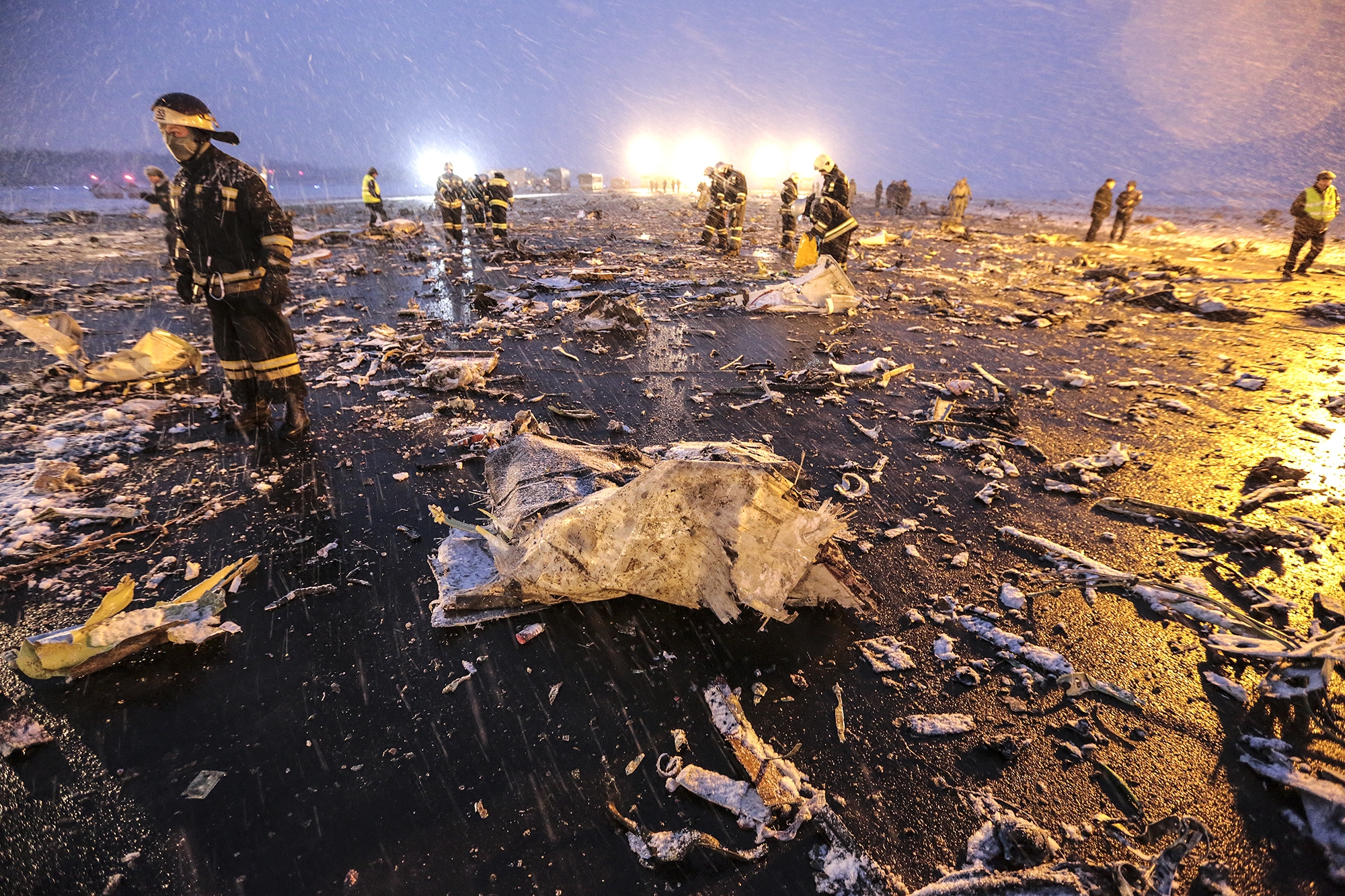

The Russian Interstate Aviation Committee published an interim report, detailing the progress of their investigation into the cause of the fatal accident involving the flydubai Boeing 737-800 at Rostov Airport on March 19.
The aircraft operated on flight FZ981 from Dubai to Rostov. The flight to Rostov was unevenful. At 22:42 UTC (01:42 local time) in the course of the initial approach at a height of 340 meters (1115 feet), the flight received a windshear alert. The flight crew decided to go around and then continued to a holding pattern waiting for improved weather conditions.
The flight left the holding pattern at 00:28 UTC (03:28 LT) and descended towards Rostov for another attempted approach to runway 22.
As the crew were proceeding with another manual approach, they decided to go around again at a height of 220 meters (721 feet), 4,5 km before the runway. They initiated a climb with a vertical speed of up to 20 m/s (3937 ft/min) and setting the engines to maximum takeoff/go-around (TOGA) thrust.
One of the probable causes of the go-around decision could have been the 20-knot increase of indicated speed to as much as 176 knots within 3 seconds, which might have been an indication of a windshear.
In the course of the go-around the crew set the flaps to 15° and retracted the landing gear. At the height of 1900 ft (approx. 600 m) after reaching the pitch angle of 18° the pilot flying pushed on the control column, which led to a decrease in vertical acceleration of up to 0.5, increase in forward speed and, consequently, automatic retraction of flaps from 15° to 10° at a speed of over 200 knots.
The short-term decrease in engine thrust within 3 seconds resulted in decreasing speed and flaps extension to 15°, although the following crew inputs to regain maximum takeoff/go-around thrust led to speed increase and reiterated automatic flaps retraction to 10°. The flaps remained in the latter configuration until the impact.
The pilot flying, by pulling up the control column, continued climbing with a vertical speed of as much as 16 m/s (3150 ft/m).
At a height of 900 m there was a simultaneous control column nose down input and stabilizer nose down deflection from -2,5 deg (6,5 units) to +2,5 deg (1,5 units). The FDR recorded a nose down stabilizer input from the stabilizer trim switch of the control wheel lasting 12 seconds, while the CVR record contains a specific noise of rotation of the trim wheels located on both sides of the central pedestal. As a result the aircraft, having climbed to about 1000 m, turned into descent with a negative vertical acceleration of -1g. The following crew recovery actions did not allow to avoid an impact with the ground.
The aircraft hit the runway about 120 m from the threshold with a speed of over 600 km/h and over 50 degrees nose down pitch.
IAC recommends among others to give pilots additional training on elements of go-arounds in various conditions, in manual control mode with two engines operative from various heights and with insignificant flight weights.
|
|
|
Bombardier Defense will provide three Global 6500 aircraft to fly maritime surveillance missions for the Australian Border Force. Metrea - the originator and leading provider...
Which strategy leads to cost-effective, climate-friendly aviation in 2070? Four scenarios from the Bauhaus Luftfahrt think tank illustrate the impacts of different transformation paths. Key points: In...
Bell Textron delivered new Texas Department of Public Safety’s Bell 407GXi. This delivery comes on the heels of an announcement made during Verticon earlier this year h...
U.S.-based aircraft management, fractional ownership, jet cards, and charter services operator Airshare is equipping its fleet of Embraer Phenom 300s with the Gogo Galileo HDX system. The up...