


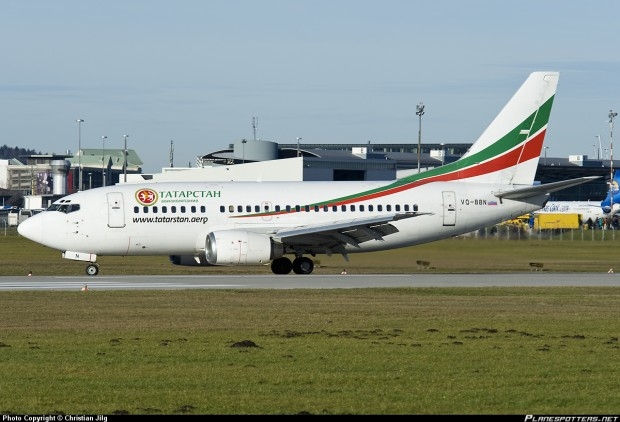
Pilots of a Tatarstan Airlines Boeing 737-500 had not realised the autopilot had disengaged as they attempted a go-around at Kazan, during which the aircraft entered a steep dive and disintegrated upon striking the ground.
Russia’s Interstate Aviation Committee says that two “weak” pilots, with poor training, had been paired on the flight from Moscow – a situation which presented a “significant safety risk”.
Its inquiry into the fatal crash, on 17 November 2013, catalogues a series of failings.
The 737 had been considerably off course as it made its initial approach toKazan, using the standard UW29D approach pattern to runway 29.
It passed waypoint MISMI – a key reference on the pattern – some 4km north of the correct position which meant that, after the aircraft made the long left turn onto a westward heading, it was far to the right of the runway centreline and unable to capture the localiser.
The inquiry traced the positioning error to a “map shift”, which it attributed partly to incorrect data on the aircraft’s location fed to the inertial reference system before departure from Moscow Domodedovo.
Attempts by the crew to bring the aircraft back on course and stabilise the approach were unsuccessful and the pilots opted to execute a go-around. The 737, at this point, was around 270m (900ft) above the runway.
Despite having discussed the possibility of a go-around, the inquiry says, the crew was probably “not psychologically ready” for a missed approach. Awareness of the need to carry out the go-around increased the stress levels of the pilots.
This stress led to a “tunnel effect” and disconnection of the autopilot was “not recognised”, says the inquiry. The pilots’ workload was complicated by unnecessary communications with air traffic control, their situational awareness deteriorated and the captain lacked the skills to recover from the subsequent upset and loss of control.
The 737 initially pitched up excessively, breaching the 500m specified height for a go-around, before levelling off at some 700m and entering a dive from which it did not recover – reaching an extreme near-vertical nose-down attitude of more than 75° and hitting the ground at 240kt, just 43s after the go-around had been initiated. None of the 50 occupants survived.
Investigators believe somatogravic illusion – an incorrect perception of the aircraft’s attitude – during the night-time go-around could have played a role in the accident.
But the inquiry sharply criticises the airline’s “non-functional” safety management system and an inability to eliminate weaknesses in its flight operations. There were shortcomings in, and a lack of control over, the training regime for the crew, the inquiry adds.
Disorganisation in crew duty and rest schedules left open the possibility of fatigue and adverse effects on pilots’ performance. The crew failed to follow the ‘aviate, navigate, communicate’ principle, which prioritises control of the aircraft over matters such as radio communications and, as a result, the first officer did not adequately monitor the aircraft’s parameters during the go-around.
While the geopolitical situation contributed to economic uncertainty in Q1, market fundamentals remained healthy. The quarter showed strong demand for business aviation, reflected in increasing aircra...
Which strategy leads to cost-effective, climate-friendly aviation in 2070? Four scenarios from the Bauhaus Luftfahrt think tank illustrate the impacts of different transformation paths. Key points: In...
The European tour of Daher Aircraft’s “go-anywhere” Kodiak 900 multi-role airplane continues this week at the France Air Expo 2026 event in Lyon, France, where it will join a fast, e...
Liebherr-Aerospace and Loong Air launched a long-term collaboration, with Liebherr-Aerospace providing major repair and re-coring services for the heat transfer equipment on Loong Air’s A320ceo/...