


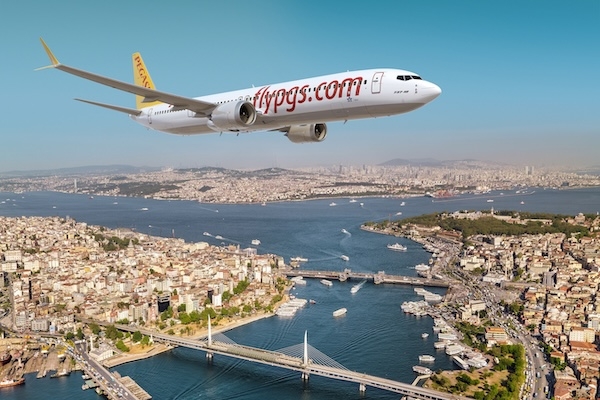
Pegasus Airlines and CFM International announced an agreement for up to 300 LEAP-1B engines which will power the airline’s future Boeing 737-10 model fleet. The contract also includes spare engines and a long-term maintenance agreement.The airline became the world’s first LEAP engine operator in July 2016, with the first commercial operation of these engines taking place on a Pegasus flight between Istanbul and Antalya.
The airline began commercial operations with CFM56-3 engines and grew to include fleets powered by CFM56-5B and CFM56-7B engines. Pegasus now continues to expand with the latest generation of aircraft powered by both LEAP-1A and LEAP-1B engines. The average age of Pegasus’ fleet is 4.9 years, making it among the youngest in Türkiye and the second youngest globally.
Güliz Öztürk, CEO of Pegasus Airlines commented: “Since we launched operations in 1990, CFM engines have played a major role in helping Pegasus build a reliable, efficient fleet that serves our customers. We have been extremely pleased with the operation of the LEAP engine family and look forward to bringing the same performance and stability to our Boeing 737-10 fleet. The lower emissions and higher fuel efficiency of LEAP-1B engines will significantly contribute to both our 2030 CO₂ reduction target and the 2050 net-zero CO₂ industry emissions goal.”
Gaël Méheust, president and chief executive officer, CFM International stated: “This agreement marks a significant expansion in our very long and successful relationship with Pegasus and we look forward to providing the level of support that this airline has come to rely on from CFM. We believe that the LEAP-powered 737 MAX 10 will be an invaluable asset in Pegasus’ continuing expansion, providing longer range, lower emissions, better fuel efficiency, and unequalled reliability.”
With more than 4,000 aircraft delivered to date, CFM LEAP engines have experienced the fastest ramp-up in commercial aviation history. Advanced technologies like composite fan blades and ceramic matrix composites deliver an engine that’s 15% more fuel efficient, with 15% lower carbon emissions than prior-generation CFM56 engines. Backed by advanced health monitoring systems and an open MRO ecosystem, CFM LEAP engines offer mature reliability and enable high asset utilisation for narrowbody aircraft.
AIR announced a strategic partnership with Dynon Avionics as its exclusive avionics provider across its aircraft portfolio. The portfolio includes the AIR ONE personal eVTOL and the company&...
Liebherr-Aerospace and Loong Air launched a long-term collaboration, with Liebherr-Aerospace providing major repair and re-coring services for the heat transfer equipment on Loong Air’s A320ceo/...
The A350-1000ULR (MSN 707), the first of 12 aircraft ordered by Qantas has completed its first flight in Toulouse, France. The aircraft, fitted with special flight test instrumentation, flew for three...
While the geopolitical situation contributed to economic uncertainty in Q1, market fundamentals remained healthy. The quarter showed strong demand for business aviation, reflected in increasing aircra...