


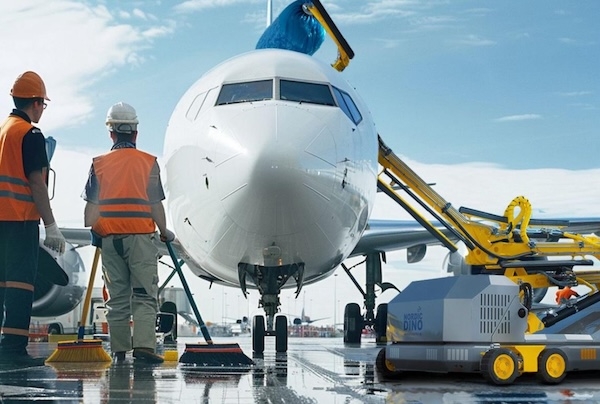
Aircraft performance during insect season faces a costly challenge that many airlines underestimate. Research shows that insect accumulation on an aircraft’s laminar flow area and increase fuel consumption by 1.1% to 4.4%, with contamination levels as low as 400 insects creating measurable drag penalties. In other words, insect season can cost airlines millions annually.
During insect season, bug residue tends to build up quickly on the nose, wings, and forward sections of aircraft. Without proper aircraft exterior cleaning, the drag they produce counteracts the force of thrust generated by engines and the lift generated by wings. This increases fuel consumption, creating additional operational expenses for airlines.
According to a detailed study by the German Aerospace Center , insect accumulation on natural laminar flow (NLF) wings can cause significant fuel penalties. The study showed that contamination levels of about 400 insects can increase fuel consumption by roughly 1.1% for shorter flights (~750 km) and up to 4.4% for longer missions.
Veronika Andrianovaite, Chief Commercial Officer of Nordic Dino Robotics commented: “Given that fuel typically accounts for 25-30% of an airline's total operating expenses, even a 1-4% increase in fuel burn due to insect contamination can cost airlines millions of dollars, especially for fleets with many daily flights. It is estimated that 50-60 % of the insects are collected during the ground run and the balance at low altitude during climb out, final approach and landing. Depending on insect size, impact angle and impact speed, insect residue can account for up to a fourth of an aircraft’s overall contamination. In Europe, for instance, it’s spring and summer. In many parts of Asia, it is linked to the monsoon season, which typically brings increased rainfall and humidity and can last until October. Using modern aircraft washing robots, such as the Nordic Dino, can help to reduce aircraft exterior cleaning times by up to 80%. For wide-body airliners like the Airbus A330 and the Boeing 777, the time spent on exterior cleaning can be shortened from 8 to 4 hours, and for narrow-body jets like the Boeing 737, the required aircraft-on-ground time is reduced from 3 to 1 hour.”
The threat of insect contamination is typically limited to operational phases close to the ground. Even during critical phases of flight, the aircraft speed is high enough to cause a rupture of the insect body.
Given the cost impact of insect contamination, frequent aircraft cleaning becomes critical during peak insect activity periods. With airlines currently in high season across many regions, efficient cleaning solutions are essential for maintaining operational performance.
Robotic aircraft cleaning equipment offers a fast and safe solution to remove contaminants, including dead bugs – especially crucial during high-frequency, warm-weather operations when insect buildup accelerates, says Andrianovaite:
Aircraft washing robots eliminate long hours of manual labor-intensive washing procedures. In an industry that requires the highest levels of efficiency, these solutions bring serious long-term benefits – making sure tiny insects don't create big problems for performance and profitability.
Baltic Ground Services, an international provider of ground handling and aircraft fueling services, has expanded its cooperation with Turkish leisure carrier Freebird Airlines across several airports...
SD Government, a Gogo company serving the military and government markets, announced today that it has secured a multi-year framework contract from the U.S. Department of Commerce's National...
dnata has secured a new multi-year contract with Silk Way Group to provide cargo and freighter handling services at Singapore Changi Airport (SIN), further strengthening a longstanding global par...
Lufthansa is focusing more than ever on premium service: Following the introduction of the new in-flight service on all long-haul flights in early May, the number of destinations where passengers can...