


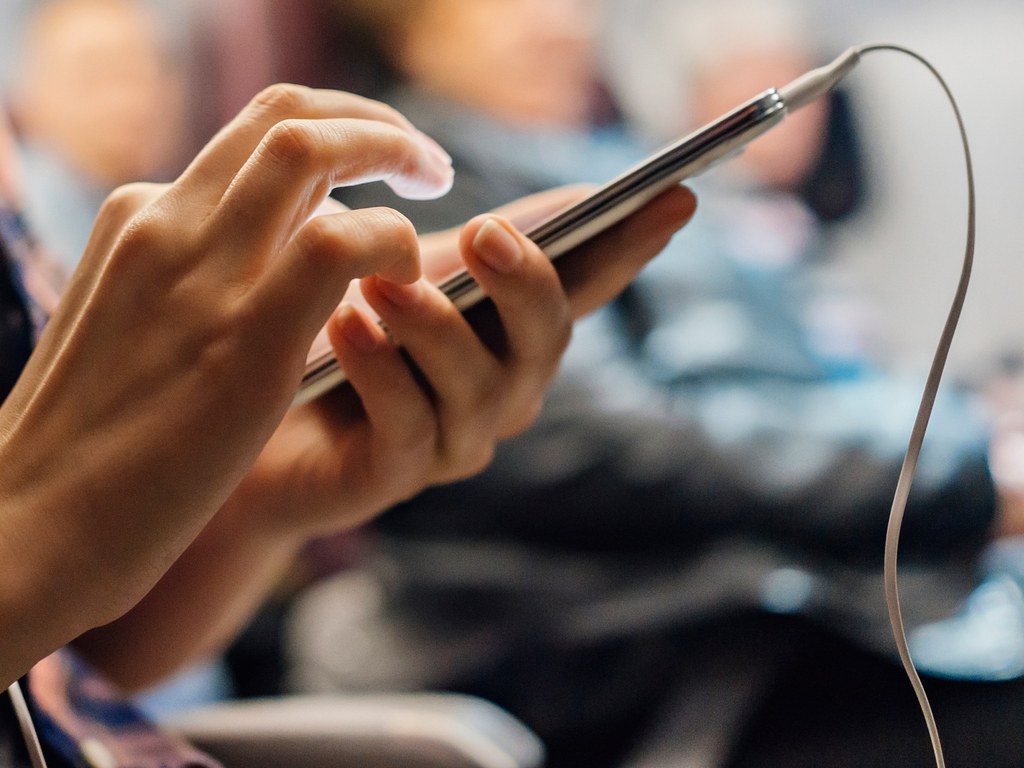
There's hype around putting phones on airplane mode during a flight. But what's it all for?
There are a lot of rules on airplanes. Some are unspoken, personal, and up for interpretation (don't recline your seat while the person behind you is eating; don't go into the lavatories barefoot), while others are official policy, announced over the intercom before a flight's departure. And after we've been asked to buckle our seat belts, put our tray tables up, and move our seats forward, we hear it: the request to turn our electronic devices off completely, or put them on airplane mode. But given that we can use our mobile devices nearly anywhere these days—and hey, that there's strong WiFi at 35,000 feet—what's this all about? If you do leave your phone on, how does it affect the plane?
For starters, it's mostly about safety. And while the U.S. ban was initially implemented in the 1990s over fears about mobile frequencies leading to a malfunction of the plane's electronic systems—or worse yet, a crash—there is no evidence that this has ever been the case. Still, pilots have noted that cell phones transmitting signals can cause audible interference on the aircraft’s radios, likening it to the sound of a CD skipping. This interference, in turn, could potentially block radio frequency for one or two seconds and lead to confusion between the pilots and air traffic control.
Whether a phone will cause such interruption depends on a variety of factors: if the device is sending or receiving a call at the edge of cell reception (typically between 5,000 and 10,000 feet), proximity of the phone to the cockpit, and the model of device. One pilot estimated hearing such blips on 2-3 percent of his flights, and with new planes, phones, and updated on-board technology, it is becoming even rarer. As for what happens to passengers who don't switch their phones to airplane mode? Short of a reprimand from a flight attendant, not much.
African Business Aviation Association announced the launch of a landmark research project that aims to advance the understanding, perception, and knowledge of the sector across the African continent.&...
Riyadh Air officially launched its domestic operations to King Abdulaziz International Airport (JED) in Jeddah. The milestone marked a significant step in the airline’s network expansion fr...
Air bp is proud to celebrate 100 years serving the global aviation industry. Since its creation in 1926, when aircraft were still made of wood and canvas, Air bp has remained central to the industry&#...
Bombardier delivered the first Global 8000 aircraft in Africa to BUA Group, a Nigerian-based multinational company with interests across cement, food, oil and gas, energy, infrastr...