


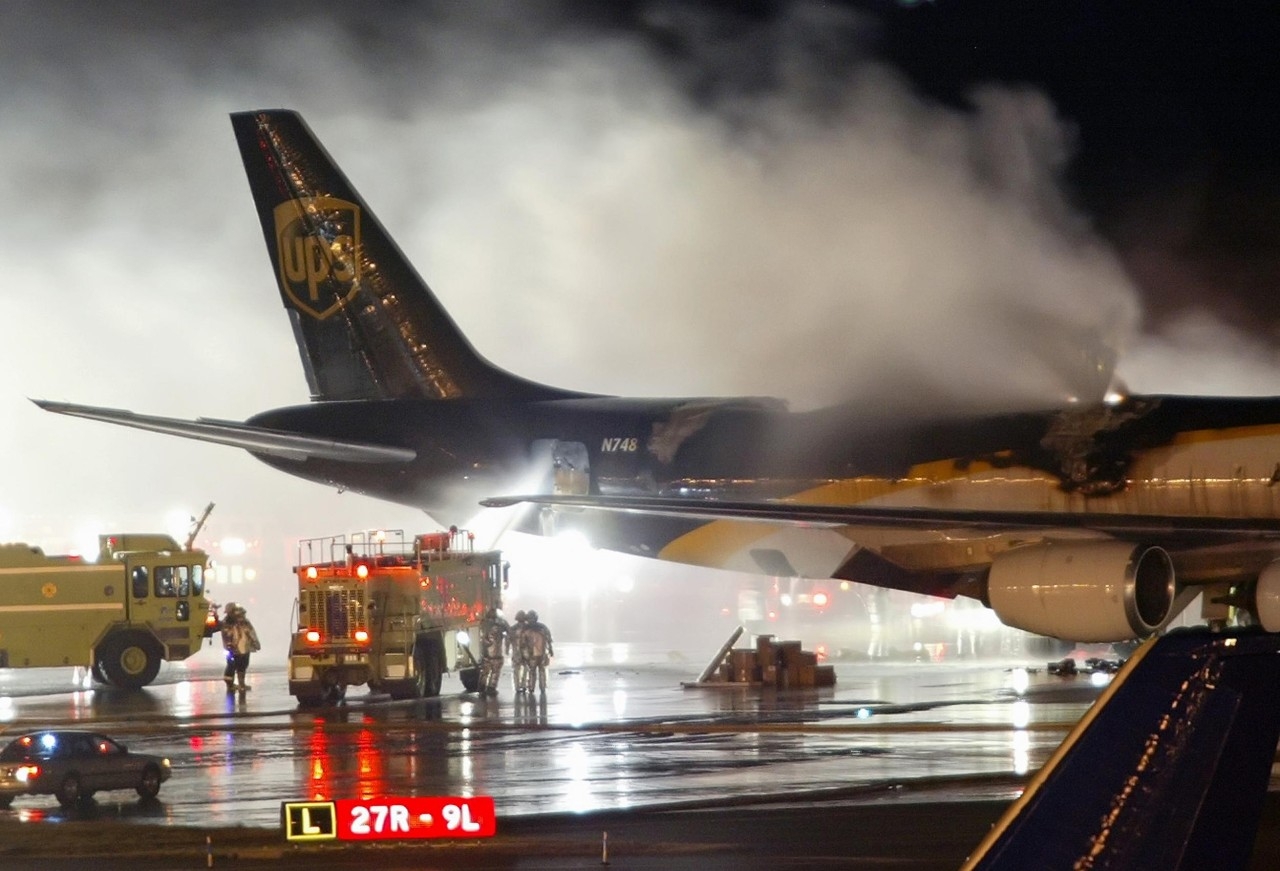
The risk of unstoppable fires is prompting U.S. officials to back a proposed international ban on rechargeable lithium battery shipments as cargo on passenger airlines.
“We believe the risk is immediate and urgent,” Angela Stubblefield, a Federal Aviation Administration hazardous materials safety official, said at a public meeting on Thursday. She cited research showing the batteries can cause explosions and fires capable of destroying a plane.
Billions of the lithium-ion batteries are used to power consumer electronics ranging from cellphones and laptops to power tools and toothbrushes. Tens of thousands of the batteries are often shipped on a single plane.
FAA tests show that even a small number of overheating batteries emit gases that can cause explosions and fires that can’t be prevented by current fire suppression systems. Airlines flying to and from the U.S. that accept lithium battery shipments carry 26 million passengers a year, Stubblefield said.
Thursday’s meeting was called to discuss what position the U.S. will take on the issue at an upcoming international aviation safety meeting. The International Civil Aviation Organization, a U.N. panel, is scheduled to take up the question of the safety of battery shipments at a meeting in Montreal later this month. ICAO issues global aviation safety standard, although it’s up to countries whether to adopt them.
The government’s announcement was the first time the U.S. has taken a formal position on the question of banning the battery shipments, and is particularly important because the U.S. has more influence at ICAO than any other country.
However, Congress has prohibited the FAA from acting on its own to bar the shipments on flights to the U.S. A 2012 law says the government can’t issue regulations related to lithium-ion battery shipments that are any more stringent than ICAO regulations unless accident investigators can show that a plane was destroyed by a fire started by the batteries.
Investigators say that’s nearly impossible to do, since the evidence needed to reach such a determination is usually destroyed by the fires. Lithium batteries are suspected in the destruction of three cargo planes.
The International Federation of Air Line Pilots’ Associations has proposed that the ICAO panel adopt a ban until better packaging or other measures can be developed to reduce the risk.
Earlier this year, aircraft makers including Boeing and Airbus called the battery shipments an “unacceptable risk.” Boeing and Airbus also sent service bulletins to their airline customers warning of the risks revealed by FAA’s tests.
As a result of the FAA tests, more than a dozen airlines have stopped accepting any battery shipments, or large quantities of batteries shipped together. ICAO also sent a bulletin to airlines this summer urging them to conduct safety assessments of their cargo operations to determine if they can safely handle battery shipments.
Janet McLaughlin, another FAA hazardous materials official, told the meeting that the U.S. position at the ICAO meeting will be that the ban should include all cargo shipments of the lithium batteries on passenger planes, not just bulk battery shipments.
The ban wouldn’t apply to cargo airlines or to other kinds of batteries. It also wouldn’t apply to lithium-ion batteries that are packed inside equipment. For example, a shipment of cellphones with lithium batteries inside them would still be allowed. FAA officials have said being inside a device lessens the risk that a short-circuiting battery will affect other batteries.
Officials from the rechargeable battery and cargo airline industries spoke against a ban at the meeting.
Passenger airlines are often paid by cargo airlines to carry shipments to destinations they don’t service. A passenger airline ban would means some places around the world won’t be able to receive battery shipments, industry officials said.
George Kerchner, executive director of PRBA — The Rechargeable Battery Association, said some airlines have conducted the safety assessments and determined they can safely transport the batteries. He said the FAA should leave the question of whether to transport lithium batteries up to the airlines, which are better able to determine what they can do safely than the government.
The U.S. is also backing a proposal to prohibit shipments in which thousands of small packages containing a handful of batteries are bundled together in a single cargo container. If ICAO agrees to a ban, the proposal would only apply to cargo aircraft. If not, it would apply to both passenger and cargo aircraft.
Similarly, the U.S. is backing a proposal to require that batteries offered for shipment be only 30 percent charged. The less energy in the battery, the lower the risk.
Affirming Cathay’ ongoing commitment to growing Hong Kong’s connectivity with Belt and Road countries, Cathay Pacific is pleased to announce plans to launch direct flights to Almaty,...
Bell Textron delivered new Texas Department of Public Safety’s Bell 407GXi. This delivery comes on the heels of an announcement made during Verticon earlier this year h...
Baltic Ground Services, an international provider of ground handling and aircraft fueling services, has expanded its cooperation with Turkish leisure carrier Freebird Airlines across several airports...
The A350-1000ULR (MSN 707), the first of 12 aircraft ordered by Qantas has completed its first flight in Toulouse, France. The aircraft, fitted with special flight test instrumentation, flew for three...