


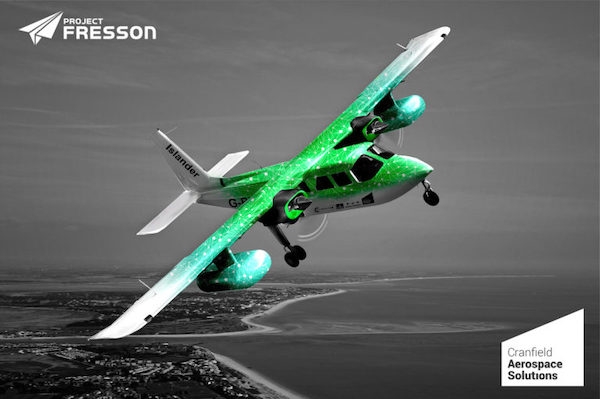
easyJet is working with Cranfield Aerospace Solutions to support the development of its hydrogen fuel cell propulsion system for commercial aircraft, as part of the airline’s ambition to de-carbonise aviation. Cranfield Aerospace Solutions is developing its hydrogen fuel cell propulsion system for an existing 9-seat Britten-Norman Islander aircraft, which is planned to be flying by 2023 and is now working with easyJet to understand how the adoption of zero-carbon technologies could integrate with airline operations for the future introduction of the technology.
easyJet will support Cranfield Aerospace Solutions on the project, providing an airline operator’s perspective on the development of hydrogen propulsion and internal expertise, to assist in the development of this technology for commercial aviation.
David Morgan, Director of Flight Operations, easyJet, commented: “easyJet remains absolutely committed to sustainable flying and a towards a future with zero-emission flying. We know that technology is a key driver to achieve our decarbonisation targets with hydrogen propulsion a frontrunner for short-haul airlines like easyJet. We are dedicated to working with industry-leading partners to support the development of these promising new technologies and we look forward to collaborating with Cranfield Aerospace Solutions to support bringing this technology to maturity as early as possible.”
Paul Hutton, Chief Executive Officer, CAeS, said: “CAeS is committed to ensuring the wide-spread adoption of zero-emissions aircraft and for this to succeed, the solutions must be commercially viable. We are delighted to be working with easyJet which, as Europe’s leading airline, is ideally placed to help shape our development with the end-user in mind. Our 9-seat hydrogen fuel cell-powered B-N Islander development is a vital first step in our journey to design and manufacture larger, longer range, regional aircraft between 19 and 100 seats. To have easyJet come with us on this journey is a great example of how organisations large and small must come together to secure the future of our industry and the planet.”
Championing the development of a zero-emission aircraft to de-carbonise aviation has long been a focus for easyJet and the airline is working with partners across the industry like Cranfield, as well as Airbus, Rolls-Royce and Wright Electric, to accelerate the development of zero-emission technologies and supporting infrastructure. The airline is optimistic that it could begin flying customers on planes powered by hydrogen-combustion, hydrogen-electric or a hybrid of both by the mid to late-2030s.
In November, the airline announced that it has joined Race to Zero, a global UN-backed campaign to achieve net-zero carbon emissions by 2050 at the latest. In joining Race to Zero, the airline is committing to set an interim science-based target for 2035 as well as to reach net-zero carbon emissions by 2050, of which technology for zero-emissions flying will play an important part.
In 2019, it became the first major airline worldwide to offset the carbon emissions from the fuel used for all its flights and currently remains the only major airline in Europe to do so. This comes at no additional cost to its customers and the airline only supports projects that are certified by either Gold Standard or Verified Carbon Standard. This is an interim measure while new technologies are developed.
Beyond carbon, easyJet is focusing on reducing plastic – more than 36 million single-use plastic items were eliminated – as well as reducing waste within its wider operations and the supply chain. The airline recently introduced new crew uniforms made from recycled plastic bottles. With 45 bottles in each uniform, this has the potential to prevent 2.7 million plastic bottles from ending up in landfills or in oceans over the next five years.
Dassault Aviation Falcon 10X has successfully completed its first flight, demonstrating the program’s maturity and marking the launch of the flight test campaign.Test Pilot Sébastien...
Embraer signed a new long-term agreement with the Brazilian Air Force to provide support solutions for its KC-390 Millennium fleet. The agreement strengthens the partnership between Embraer and t...
Lufthansa Technik Philippines, the joint venture between Lufthansa Technik and the MacroAsia Corporation, is significantly expanding its footprint in the Philippines with a new base maintenance facili...
Etihad Airways celebrated the inaugural flight of its iconic Airbus A380 to Japan, which touched down at Tokyo’s Narita International Airport on 18 June. The arrival marks a landmark moment for...