


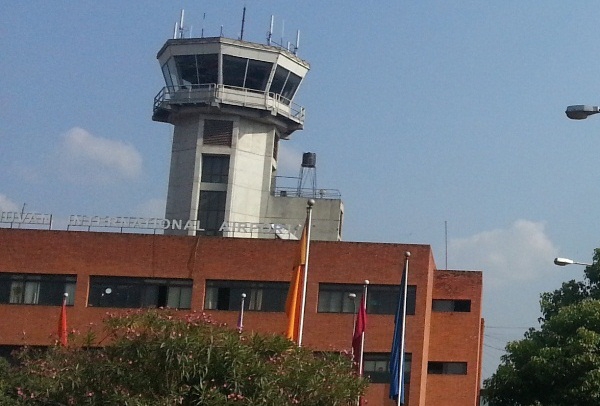
The Department of Hydrology and Meteorology, as well as the Air Traffic Control tower, often provide wrong aviation meteorology information to pilots though meteorological observations and reports for air navigation have a direct link to aviation safety.
Talking to this daily, the pilots said they constantly got misleading meteorological information from the service providers.
“Tower informed us that there was some 3 km of visibility this morning but DHM’s update showed it to be less than 1.5 km while Kathmandu was engulfed by haze,” a senior captain told this daily recounting the communication with the air traffic control tower at Tribhuvan International Airport.
Wrong transmission of such sensitive information could invite disaster, he said. The pilots who mainly fly Boeing 757-200 need at least 2.8 km of visibility for landing at TIA.
Not only at TIA, pilots have also been facing a tough time at Lukla-based Tenzing Hillary Airport while they prepare for landing at the world’s most dangerous airport.
“Information being provided by Lukla tower is not sufficient and is often miscalculated and misleading,” said a domestic airlines pilot who flies daily to Lukla with climbers and trekkers on board.
According to him, there is an urgent need for CAAN to monitor whether their staff in Lukla follow standard operating procedures or not.
The pilots have noted serious deficiencies in the quality of aviation meteorology services though the official aeronautical information publication for Nepal, issued by Civil Aviation Authority of Nepal, specifies that the high quality and timely services are rendered in accordance with the provisions of Annex 3: Meteorological services for international air navigation of the International Civil Aviation Organisation.
“In view of the outstanding need for quality meteorological data, the ICAO in its annex introduced the requirement for a quality management system like ISO effective from 2012, as the aviation meteorology is essentially considered the backbone of civil aviation on matters of safety, regularity as well as efficiency.”
Apart from a problem in measuring observation and reporting various parameters, including wind speed, wind direction, pressure altitude, temperature, dew point and runway visual range, a senior captain claimed that the information on aviation weather provided by tower and DHM was often contradictory.
DHM’s Director General Rishi Ram Sharma, however, claimed that the department, with its limited resources, was providing high-quality service abiding by the standard operating
procedures. “But, most of the pilots never attend Met briefing before flying aircraft,” he accused. Senior CAAN officials, as well as TIA tower controllers, refused to comment on pilots’ concerns.
Cirrusannounced its new SR Series Annual Flight Review Course, a Cirrus Approach module designed to promote continuous flight training, pilot proficiency, and safety for all pilots, inc...
For over 25 years, Jetfly has stood out in Europe as a pioneer of a distinctive shared ownership model in business aviation. Designed to offer the flexibility of private aviation without the constrain...
When Stephanie Goetz recently sat down on Viasat’s viral podcast Above the Noise, one thing quickly became clear: her journey into aviation was anything but conventional. In the e...
Bombardier and ELIE SAAB unveiled a new chapter in business aviation: a bespoke cabin design for the Global 8000 aircraft that redefines the onboard experience through the lens of haute cout...